
Archive for April, 2013
PBP Fridays: I is for Iah, The Moon
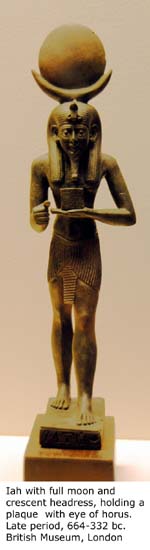 To ancient Egyptians, the deities associated with the sun were usually goddesses, typically playing the role of the protective and vengeful Eye of Ra, and the deities Who were associated with the moon were usually male. Iah, Whose name means “moon,” was not only a lunar god—He was the moon itself, in much the same way that Aten was the sun in the physical-ball-of-boiling-gasses sense. While most of Iah’s attributes were usurped over time by more popular gods like Djehuty (Thoth) and Khonsu, He was originally associated with the symbol of the crescent moon, the ibis, and the falcon. Iah can be shown as the “adult” version of Khonsu, Who is a child god, when Iah wears a full wig instead of Khonsu’s youthful side-lock. In addition to the wig, Iah is depicted with a beard, a tall staff, and a headdress of either the full moon and crescent moon (shown right) or the Atef crown, most commonly worn by Wesir (Osiris), atop the moon symbols; rarely, Iah can also be seen with an ibis head.
While Iah never gained great cult importance or popularity, the moon as the left eye of Heru (Horus) had plenty of mythic significance. In the Contendings of Horus and Set, wherein which the two gods battled for the throne that Wesir (Osiris) had vacated upon His death, Set wounded and/or tore out Heru’s eye. The waxing and waning of the moon reflected its destruction and restoration; that Djehuty often aided Heru in finding or healing His eye only linked Djehuty more strongly with the moon. Lunar eclipses could also reflect tumult among the Netjeru and damage done to Heru’s eye; some myths suggest that Set took the form of a black pig and swallowed the moon whole, only regurgitating it at Djehuty’s intervention. The lunar cycle has also been linked to Wesir’s own destruction and rebirth as the king of the dead, which may tie into why Iah is occasionally depicted with Wesir’s Atef crown.
As a small modern offering:
Hail, gleaming Eye of the moon!
Iah Who shines as the sun in the night,
Whose form is silver and ever-shifting,
I meet Your gaze and admire Your beauty.
Hail Iah, the moon at every shape!
Your face is always turned towards us below
even as You slice into darkness
and then back into purest light.
Hail Iah, Who gives us sight in shadow!
Hail Iah, the falcon’s watchful Eye!
Sources:
- Egyptian Mythology (Geraldine Pinch)
- The Complete Gods and Goddesses of Ancient Egypt (Richard Wilkinson)
- The Routledge Dictionary of Egyptian Gods and Goddesses (George Hart)

Last year’s first I post was on immanence.
 No Comments »
Sekhmet and Serqet
(…make a pretty good team.)
I rarely experience my gods together. I relate to Them one-on-One, for the most part, though I suspect there occurs the spiritual equivalent of passing in the halls and giving each other a nod and a wave when I involve Them sequentially in ritual.
So it was with some surprise (and an immense wave of gratitude) that I realized that both Sekhmet and Serqet were present when I settled into the dentist’s chair for five hours of less-than-pleasant necessary procedures. It helped to focus on Them instead of the sounds, smells, and sensations of the work being done on my body.
Sekhmet overlaid my dentist (a lovely, skillful lady) with Her crisp I’m-working-right-now red, a sharp difference from the normal stormy, hearth-red that I associate with Her. I knew I was in good hands, both human and divine.
Serqet was a yellow scorpion, roughly as long as my hand, perched on my solar plexus like a cat might sleep atop me. She (or one of Her netjeri?) was a comforting, protective weight keeping me still and calm.
When my focus started to drift too far, I remembered the neopagan tune that goes with the chant, “Isis, Astarte, Diana, Hecate, Demeter, Kali, Inanna,” and adapted it:
Sekhmet, the Red Lady, guides the surgeon’s hands;
Serqet the Scorpion guards me.
I am immensely grateful to Them both for a successful procedure and for Their companionship through those hours… and still a little awed at how right it felt to have both of Them there, working together, in that situation.
Dua Sekhmet! Dua Serqet!
PBP Fridays: H is for Hyena
 The spotted hyena is very close to my heart and my personal mythos – I can’t believe I haven’t written about them before now. Surpassing the wolves that I love and nearly all of the big cats that I adore, Hyena joins Scorpion, Snake, and Barbary Lion in the cluster of those few deeply impactful creatures that inspire, educate, and elucidate. If ever I refer to the “red hyena,” it is the spotted hyena, not any of its smaller extant cousins or extinct ancestors.
For those unfamiliar with spotted hyenas, or familiar only with some of the persistent untruths about them, I will give you a condensed overview. (Click here if you want to skip past the zoology lesson to where I talk about Hyena in a symbolic and personal sense.)
body
Spotted hyenas (Crocuta crocuta) are the largest living hyenas, native to Sub-Saharan Africa, weighing 90-150 lbs and standing up to three feet at the shoulder. Females are larger than males and are the dominant sex, and (in)famously have erection-capable pseudo-penises instead of mammal-normative vaginal openings, accompanied by pseudo-scrota. Hyenas are neither felidae or canidae, though they more resemble bearish canids than felines; their shoulders are high, their backs sloped, and their rumps curved instead of squared off. They have medium-length, brushy tails and large, rounded ears, with less of a visible spinal mane than striped and brown hyenas. Spotted hyenas are varying shades of medium grey-brown to golden-tawny with dark or reddish brown spots, a dark tail, and a dark muzzle; they have thick skin that is not easily penetrated by canine bites.
hunting and eating
Hyenas can hunt alone, in small groups, or in large groups, as well as scavenge; they can eat and digest every part of an animal, including bones, hooves, and waste, and have no problem eating a carcass that’s submerged or floating in water. Their usual prey consist of the various ungulate species of the African savanna, such as wildebeest, zebra, and gazelle. Their jaws are stronger than those of the brown bear and generate nearly half again as much force as a leopard’s bite. Their hearts are proportionately large, giving them immense endurance in long hunting chases, and they typically hold large territories in which to wear down fleeing prey. They closely respect territorial boundaries, even to the point of allowing prey to escape if it crosses out of their lands. Hyenas use all of their senses, tracking live prey by sight, hearing, and smell; they find carrion by smell, by watching for descending vultures, or by listening for scavenging opportunities; hyena ears are sensitive enough to hear other predators hunting or feeding up to six miles away. (However, the myth that hyenas scavenge lion kills is not only misleading, but usually happens the other way around. Spotted hyenas and lions directly compete with each other, and while hyenas can occasionally eat side-by-side or drive lions off, they usually just step back and wait for the lions to finish. Hyenas will often steal kills from cheetahs, though, and occasionally from leopards.)
society
Hyena social structure is the most complex of any carnivore, rivaling some primates, but is competitive instead of strictly cooperative. Despite this, they are highly socially intelligent and can problem-solve cooperatively. Hyenas exhibit very detailed social knowledge, able to recognize great-aunts and the reliability of other individuals; their dominance is based not solely on physical force but on networks of allies. Hyena groups are called clans and can include as many as 80 individuals. Clans are matriarchal, and even the lowest-ranking females dominate the highest-ranking males. Clans live in one or more communal dens, which frequently have several entrances; adults usually can’t use all of the den due to their size, as they usually use dens dug by other animals. They have a wide range of social interactions, including greeting each other by licking the other’s genitals; erection is a sign of submission, more common to males than females. The signature hyena giggle is actually a sound usually made in fear, when attacked or chased.
cubs
The mother alone cares for her cubs, with no assistance from the father or other females; hyenas don’t form long-lasting pair-bonds. Females actively prefer younger males as mates, and older females additionally prefer males with whom they have had amicable past relationships; passive males win more females than aggressive ones. Mothers usually give birth to just two cubs, and the rank of those cubs corresponds to the mother’s, as she imparts to them her general androgen levels, which are directly related to her dominance and her rank within the clan. Hyena cubs are the only carnivorous mammals to be born with their eyes open, and they attack each other shortly after birth, frequently killing the weaker sibling, especially in same-sexed litters. Spotted hyena milk is enormously protein- and fat-rich, and cubs will nurse for over a year, though they mature socially and physically with remarkable speed. They are sexually mature at three years and have an average (zoo) lifespan of twelve years. Hyenas have a number of antibodies against deadly diseases, including rabies.
hyenas in myth and art
 Hyenas have an generally negative place in the mind of humans, both Western and African… but, nonetheless, they have had a place there since Palaeolithic times. They are depicted in Upper Palaeolithic rock art in France, including the Chauvet Cave, Lascaux, Le Gabillou Cave, and La Madeleine rock shelter. In Africa, the hyena is typically seen as abnormal, dangerous, ugly, greedy, and dirty, as well as often related to witchcraft; Western culture traditionally thought of hyenas as cowardly, unholy, and comically stupid. However, in some East Africa mythology, the hyena is a solar animal that brought the sun to warm the earth. There are multiple myths of were-hyenas, but they do not return to their human selves when killed. Ethiopia has stories of the King of Hyenas, an albino animal with great power. In some African cultures, hyenas are linked to the end of rituals (because they devour corpses) or with liminality (because they’re frequently considered hermaphrodites and thus “in-between” sexes), or with fortune-telling and apotropaic properties. Some hunters treat slain hyenas with the same respect as they would deceased tribal elders to avoid vengeance by hyena spirits.
Much like I did for Harpy Eagle, I’m going to distill some symbolism from all of the awesomeness that is the spotted hyena. As before, all of this is my individual interpretation and is not (to my knowledge) drawn from any other source, let alone any traditional/tribal one. I’m also leaving out some of the most general and obvious bits (like their environment and symbolism related to being a mammal and a carnivore).
- Hyenas have immensely powerful jaws and can crush, devour, and digest just about anything, including things that other carnivores cannot. [Drawing nourishment and sustenance from anything, without metaphorical indigestion. Sustaining oneself on what others couldn’t access or couldn’t bear.]
- Hyenas are female-dominant, and the females’ genitals resemble the males’ with a startling degree of accuracy, including function. Typically dominant male displays, such as erections, are actually signs of submission in hyenas (and are no longer only the domain of males). [Balancing a strong feminine with a soft masculine. Gender-bending, both as an individual and as a society.]
- The most choice male mate is the most passive. [Choosing gentleness and longevity of (prior) relationship over aggression and force.]
- Hyenas use all of their remarkably keen senses with no particular bias. [Not only the ability to actively intake all sorts of things, but to passively observe with every sense and to use the best sense for the job. Overall: flexibility, diversity.]
- Hyena cubs are born with their eyes open and mature physically and socially very quickly. [Being precocious, either as a literal child or, more metaphorically, as a “child” in a given situation, field, activity, or group.]
- Hyenas have large territories and respect their boundaries. [Holding one’s own space, even when it’s not small, and letting others have their own.]
- Hyenas are unaffected by rabies and certain other deadly diseases. [Being immune to what is normally crippling and fatal.]
- Hyenas are plentiful in a wide variety of climates and terrains and can live alongside or compete against a staggering number of other species. [In a word or two: survivable, adaptable.]
- Hyenas both cooperate with and compete against members of their own clan. [Being precariously balanced and actively variable between self-interest/self-gain and group-interest/group-gain.]
- Hyenas eat the dead, both animal and human. [Being the link between death and life; doing the necessary job to maintain a larger balance, despite the unfortunate reputation that comes with it.]
- Hyenas are neither felidae nor canidae and have frequently been mistaken for wolves or various hybrids of other carnivores. Even today, many African languages do not distinguish between spotted hyenas, striped hyenas, and brown hyenas. [Being unique; being falsely categorized when the truth of uniqueness is not comprehended or acknowledged.]
hyenas and Set
As an additional note: While some modern Kemetics associate Set (Seth, Sutekh) with hyenas, at least in theory, I must disagree with this concept. Set Himself is the strongest of the Netjeru and is very much masculine, for all that He is effectively bisexual in His mythology; there is nothing to draw ties between Him, a dominant/dominating male god, and the female-dominant spotted hyena whose males are most successful when they are at their most submissive and friendly. There is no solid correlation between a strong man’s bisexuality and the hermaphroditic/gender-bending characteristics of the hyena. While a link may be drawn between Set and hyenas based on shared liminal natures, it is a weak one at best, and I don’t feel that correlation can stand firm beneath the contradiction of more prominent attributes.
the red hyena
For a Water-child, I have a strange predisposition towards red or Fire-related entities, perhaps as a way to balance out my own internal biases; and the red hyena is no exception. I began working with Hyena as an older adolescent and adopted her social behaviors in order to achieve a higher functionality in certain inescapable social situations. (I am innately a solitary hermit, so trying to wrangle a raucous group of teenagers as an otherwise-quiet peer-leader was a challenge. Hyena helped.) Since then, I have balanced my inner tendencies with Hyena’s patterns, and I can measure my success in real-world terms: I am currently managing a department of some fourteen people, all creatives and thus fiercely individualistic and opinionated, and I am doing so with extreme success. Additionally, Hyena’s gender-bending fits well with both my habit of flipping a dichotomy upside-down (which shines most brightly in my fiction) and my own genderfluidity. I am, in fact, so enamored of spotted hyenas that I am retelling a couple of my favorite ancient Egyptian myths through a fictional society of hyena-people, based heavily on real spotted hyena behaviors and facts; that novella is about 60% done and has not ceased to delight me yet.
I end this long and information-heavy entry with this, a gorgeous photo of the red hyena:

Image by Will O’ Wisp on Flickr.
Last year’s second H post was on Hethert-Nut (which became a permanent page on the site).
KRT: Feeling Inadequate
This post is part of the Kemetic Round Table, which aims to answer some of the most common questions and provide a wealth of diverse options for the Kemetic novice to explore.
Every Kemetic can feel inadequate at times; how do you handle those feelings in your own practice?
An excellent question, and one that cuts close to home. I can be… territorial, shall we say, and along with that sense of territory is a sense of what can threaten that territory. Anyone I perceive as “bigger” (more knowledgable, more skilled, more experienced, more authoritative) can trigger an internal alarm that lets me know that what’s mine may be contested by this “bigger” entity… and, in fact, I could outright lose a showdown if one occurred.
I typically experience one of two instinctive reactions to this feeling: avoidance (if no one knows what I have, they can’t take it!) or defensiveness (it’s mine, I’ll fight for it!). Neither are particularly helpful, but my third intellectual response, which employs logic and reason and reminds my toothy animal brain that people are not actually trying to steal my shit, can only balance out the knee-jerk emotions—it can’t fully override. So I wind up in this sort of frozen state, where I consciously realize what’s going on but can’t fully win out against instinct; my emotions are flailing all over the place, beneath a thin veneer of calm.
In a word, I am graceless at handling feelings of inadequacy, even if I manage to keep myself from loosing them full-force on unsuspecting passersby.
However, having such a powerful response to the imagined threat of superior force has given me ample opportunity to practice coping. There are some tried-and-true techniques that will help, even when I’m neck-deep in emotional flail:
Step away. If I’m not going to be able to handle a situation gracefully, I’ll remove myself from it, and preferably before my internal state gets too woogity.
Once I’ve stepped away, I can distract myself. If I’m feeling overwhelmed and “out-competed,” to prevent myself from going into that downward spiral of flail, I’ll change activities, locations, or trains of thought. To give a more solid example, if I’ve been looking at too much amazing art and feeling wholly inferior about my own paintings, I’ll go read a book or pick up the guitar, rather than stay on the topic of art.
Sometimes, however, I don’t want to switch topics, so after I step away, I can do it alone. If I know I’m going to get daunted if I’m exposed to too much awesomeness from other people, I’ll go do my own thing alone, outside the realm of influence of anyone else, and once it’s done, then come back and rejoin my community. A great example of this was the last KRT post; I was a few days late in writing mine, and instead of reading everyone else’s first and despairing that I could not possibly add anything of value to the conversation, I wrote mine and published it before I read anyone else’s. I might still feel inadequate after overexposure to sheer awesomeness, but at least those emotions won’t stop me from gettin’ shit done.
In almost all of these cases, part of my coping methods is self-talk. I will frequently (and usually skillfully) be able to talk myself down from most emotional peaks with enough time and quiet enough surroundings. Just as one might coax a balking horse or fearful dog into a state of greater calmness and compliance, I coax my own reactive self into a slightly more chilled-out, reasonable state. (If you’re wholly unfamiliar with the concept of self-talk, I recommend checking out What to Say When you Talk To Yourself. There’s an enormous psychological basis for self-talk being ridiculously effective.)
Because the biggest problem with feeling inadequate—in general, but especially as a Kemetic—is that it’s a lie. No one is a “better” or “worse” Kemetic. There are certainly ways in which we as individuals can change our practices to fit our own internal standards, but that’s a personal thing, not a black-and-white thing. If I don’t do a daily rite, I am not a worse Kemetic than someone who does. Having an awful lot of books on Egyptology does not make me a better Kemetic than someone who has two—or none. There is no comparison; there is no competition. And, quite frankly, if you’re in a place where there is a lot of Kemetickier-than-thou going on, you might want to seek more peaceable pastures elsewhere. No one has a right to judge others on their worth or success as Kemetics.
We’re all wonderful, fallible people. Just because we sometimes feel inadequate does not at all change the contributions that each of us bring to the world and to our faith and to our community. Feeling inferior doesn’t make us inferior, and even when we’re immersed in the flaily emotions, we are still ourselves—still Kemetics of worth and value.
If you enjoyed this post, please check out the other takes on how to deal with feelings of inadequacy by my fellow Round Table bloggers!
PBP Fridays: H is for Harpy Eagles


Last weekend, I had the pleasure of seeing harpy eagles in person for the first time at the Fort Worth Zoo. The walkway is enclosed beneath their habitat, and the male perched on the wire ceiling of the walkway with his meal while the female periodically flew from one side to the other. We could feel the wind off her wings; she was twice his size. On her last pass over our heads, a tiny piece of white down fluttered down through the wire mesh right in front of me, and I captured it carefully in both hands before it hit the ground.
I don’t usually connect strongly or easily with birds, but there was something special about the harpies (and Andean condors, but that’s for another post). My first step, when an animal catches my attention in that particular way, is to do some basic research and see what I can glean from that on a more symbolic/totemic/mythical level. If my interest or gut instinct continues to ring bells, I’ll do more in-depth research and study to continue interpreting science into symbol. (Yes, I am a zoologist-totemist. Best of both worlds!)
Harpies are very large eagles (but not the largest, as they are often described as being); they live in tropical lowland rainforests, and their wingspans are somewhat short for their overall size so they can maneuver in the dense forests. [Being sizable without forsaking agility; navigating a cluttered environment.] Like other eagles, the females are nearly twice the size of the males, but both sexes will take very large prey, up to their own weight, which is a startling feat of strength when we’re talking flying off with a live animal. [Choosing worthy and challenging targets instead of the easiest possible targets; operating at a level respective to one’s own strength and proficiency.]
Apex predators, harpy eagles primarily feed on arboreal mammals like sloths and monkeys, but will also eat other birds, reptiles, larger ungulates (even deer), or (very rarely) livestock. [Being versatile enough to find nourishment in many forms; being capable of seizing a variety of targets successfully.] Harpies have the largest talons of any living eagle, with claws longer than even a grizzly’s at 5.1 inches; their feet are immensely strong and capable of easily suppressing prey. [Extraordinary innate power, which can be used to anchor oneself or to seize and hold a target; ability to overpower and strangle.] Harpies tend to perch-hunt, scanning for prey while perched on boughs between short flights from tree to tree, but also still-hunt, which involves staying in one location and swooping down on prey when it’s spotted. They can also chase flying birds. [Versatility again in methodry; ability to keep moving or to wait motionlessly or to full-fledged chase, depending on the need.]
Harpies tend to be quiet when not attending their nests; they mate for life and raise one eaglet, ignoring their second egg unless the first fails to hatch. [Vocal when at “home” with family; focused on one partner and one offspring alone.] The nest is large, made of sticks, and frequently built in one of the tallest trees of South America, the kapok tree; it can be used for several clutches, which are spaced 2-3 years apart. [Finding safety and home-ness in high places; having a more stationary sense of home.] Both sexes will incubate the egg and bring back food for the other; the eaglet is fed and tended for the first year or more of its life. [Shared responsibilities, despite inequality in size; devotion to offspring past the point of strict necessity.]
Harpies tend to be aggressive and fearless of humans, leading them to be targeted by hunters, even though they pose no actual threat to human life as predators. [Persecution based on appearance instead of action; fearlessness in defending offspring and home.] Threatened primarily by habitat loss, they are anywhere from Critically Endangered to Near Threatened, depending on the area, but overall are classed as Near Threatened globally.
Overall, I’m getting an impression of lessons in strength (without forsaking agility), versatility (in both prey and hunting methods), and fierce devotion to (a small) family. Two particular tidbits that perked my ears were the boldness around humans and the size and strength of harpies’ talons. I am finding myself very interested… which means I get to do more and better research to see what else I can uncover. :D
Last year’s first H post was on heka (Egyptian magic).
1 Comment »
Dua Tefnut, Dua Shu!
Today is the birthday of Tefnut, goddess of moisture, and Shu, god of wind. I have been waffling about posting this prayer-poem, which is spontaneous and personal, but really, what’s the point of this spiritual blog if I’m not sharing things true-of-heart?
Tefnut—
if I may be so bold
as to touch You,
I would like to rest
my head against Your skin,
my hair mingling with Your fur
which is rain
which is fur.
I am in love
with the very idea of You,
You water-lioness,
a god-form of me,
so much greater and so deeply unknown.
You live in my head
richly adorned with greens and blues,
and I would praise Your name
with every drop of sweat,
every tear,
and every humid heartbeat.
Shu—
if I may be so bold
as to touch You,
I would like to open
my wings to Your breath,
alighting upon Your currents
like a leaf in the pulse
of the crosswinds.
I am made alive
by the wind that is Your domain,
and I have known You,
You of gold and silver light
gleaming translucent in the breeze.
Knowing You are here
to uphold the sky
and let us taste each precious breath,
I praise Your name
with every sigh,
every song,
and every filling lung.
For Tasenetnofret

I am toying with the idea of making something extra-colorful on every one of Her days; you can see a hint of Her here, on the far left, overlooking the colors I have poured for Her as an offering.
PBP Fridays: G is for Gaul
I am very much an American born of the melting pot. I’ve got blood from half a dozen different countries, at least. And, as a Caucasian mutt, I don’t really get a cultural heritage. I am way too white to so much as touch the little bit of Cherokee and First Nations (indigenous Canadian) blood in me, and I am way too American to have much to do with my French or Sicilian heritage, which comprises the majority of my European genes. Without ignoring the immense privilege that my normative Caucasian make-up affords me, I find it hard to construct a strong personal link to any “traditional” polytheist or pagan practices or religions; I am too far removed, generationally and genetically. (I mean, I’m certainly not a Kemetic because some part of me is descended from ancient Egypt.)
And yet I am some third or so French, come down from des voyageurs after mixing with the First Nations, and before Canada, there was France… and before France, Gaul. It is the most direct line I can draw if I seek my roots, and even then it is a tenuous trace. However, my love for and study of the French language has strengthened the thin, shaky path back, and my early experiences with Celtic* paganism have enriched the way. *Even if it was Irish Celtic, not mainland-Celtic.
But I have not studied Gaul (or the Gaulish language) in the same way that I have studied ancient Egypt (and hieroglyphs). Pre-Roman Gaul has not gotten as much of my attention as pre-Greek Egypt. It doesn’t help that there’s a lot more historically available on Egypt; in fact, my work as a Kemetic has taught me not just about Kemeticism but how to be a (soft) reconstructionist in the first place. I’ve learned how to interweave history and modernity, academic “facts” and personal gnosis.
And now my eyes are drawn back to Gaul, its tribes and uncertain history, its dead language and its missing pieces, its heroes and its gods. The scent of loam, the feel of bone marrow, the familiarity of the forests. I cannot tell how much of my lingering sensory-rich impressions are based in fact or in myth… but now, I think, I have the ability to learn enough to distinguish one from the other, and treasure them each in their own way. And, however clichéd it may sound, Gaul sings home to at least some part of me that yearns to answer the call.
Last year’s second G post was on being a GLBTQ pagan.
KRT: Life as a Modern Kemetic
This post is part of the Kemetic Round Table, which aims to answer some of the most common questions and provide a wealth of diverse options for the Kemetic novice to explore.
How does being a Kemetic affect your daily life, if it does?
I am going to take this question as seeking more concrete ways that Kemeticism influences my life, rather than going with my first reflexive response of “being Kemetic changes my entire outlook, which affects every second of every day.”
I do not currently perform a daily rite, but my being Kemetic does affect my day-to-day. I say my morning prayers every weekday on the way to work. I dress myself in jewelry that symbolizes and links me to my gods; they are marks that show me as Theirs, as well as objects that I can touch when I am in need or in praise. I review the Kemetic Orthodoxy calendar to see what holidays occur each day, and if I am able and eager, I set aside time to do something to celebrate, be it a quick offering or an elaborate devotion of art-making. I reach out regularly, if not everyday, to my Kemetic community, through forums and through email and through this blog. I seek my gods in the sky, in the sun, in the wind, and in Their colors.
Do you do things differently than you used to because of your faith/religion?
Yes, though trying to quantify that is a challenge, even ignoring the intangible ways that Kemeticism has altered my behavioral patterns and ways of thinking. I am certainly more active in community now, since before I had none; I am having to learn how to be social, which is an ongoing challenge, but I have found such good people that the work is worth the time and effort. Also, before becoming a Kemetic, I did not grok the concept of service, and now I think I do, at least in part. I serve where I may, and I find joy in it. As well, I have learned to understand the passion that monotheists and polytheists can feel and express towards their gods, which had baffled me to some extent before I became Kemetic.
More concretely, I paint now. I write songs now; I put guitar chords to those songs; I sing. I study hieroglyphs and history and ancient mythology; I hoard college-level textbooks on Egyptology. I write hekau and litanies and prayers. I make sacred jewelry. I do all of these things because I am Kemetic, because I am intertwined with certain Netjeru Who love music and beautiful things and creativity, Who create language, Who ask studiousness of me in exchange for Their acceptance of my never-gonna-be-a-hardcore-ritualist. While I may have wound up going this far with music-making and art on my own, without being Kemetic, it would not be anything like what it is now, and I love my crafts as they are—and as they will grow to be.
The easiest way to describe how being Kemetic has changed my life, how it affects my every day, is to say that I see more colors in everything than I did before. Imagine walking into and through a rich watercolor painting—that’s my day, right there.
If you enjoyed this post, please check out the other takes on daily life as a modern Kemetic by my fellow Round Table bloggers!

