
Archive for May, 2013
PBP Fridays: K is for Khnum’s Gift
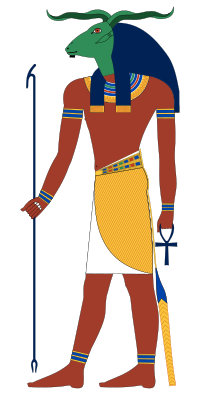 With ram-horns and ram-eyes and the breath of life,
Khnum sits at His potter’s wheel in Abu,
The Seat of The First Time;
and in that place where the world was born,
He spins His wheel and makes we mortals,
our souls and flesh as clay in His skillful hands.
Into some sweet few, a little piece of Him slips,
a seed and a spark of fragrant inspiration,
and up we rise—up she rises,
and her hands seek out the clay like His do,
and she shapes bodies and hearts like He does,
a small and lovingly-crafted reflection of His work.
Dua Khnum, Who shapes, Who creates!
Dua Khnum, Who breathes into us shining life!
Dua Khnum, Who imbues us with His craft!
For Saryt, my beloved sister and most talented and imaginative sculptor-of-creatures.

KRT: Setting Up A Kemetic Shrine
This post is part of the Kemetic Round Table, which aims to answer some of the most common questions and provide a wealth of diverse options for the Kemetic novice to explore.
Before I begin, I would like to clarify that the information in this post is my personal opinion only; it reflects the influence of Kemetic Orthodoxy’s guidelines and requirements of a shrine, but is more than just those guidelines. Specifically, in terms of purity, Kemetic Orthodoxy does not recommend having any animal products in or on a shrine, including plastics; I do not follow that restriction.
That said, let’s explore what constitutes a Kemetic shrine! For sake of simplicity, I define a shrine as a place for religious worship and activity, including making offerings and prayers. It is not just a static place to showcase icons of Netjeru; it is a place to “work” by actively participating in ritual and dialogue at or with your gods. While statues, images, and other items depicting or symbolizing a particular god can be part of a “working” shrine, the shrine is more than just those sacred objects.
Whenever possible, I recommend having a dedicated shrine space in a relatively private and undisturbed place that doesn’t get extra dirty; a corner of a bedroom or a spacious shelf in a closet will both work, as will a mantleplace shelf or small table set up somewhere things won’t get easily knocked over. However, for many Kemetics—especially those just starting out—it’s not practical or even possible to have an ever-present shrine area. Some low-tech solutions include having a TV tray you can fold out to use as needed, or clearing off a nightstand, or purchasing a cost-effective wooden shelf (even an unpainted one from Michael’s or another craft store) to use for a shrine. It is especially helpful to have an altar cloth if you can’t leave your shrine set up all the time, as the cloth helps distinguish the mundane and the sacred uses of the surface in question and to keep your shrine items clean. White is traditionally a great color for the cloth, but other solid colors or patterns can still work just fine.
There are a few items I would always recommend a “working” shrine feature, and even the most sweetly simplified shrines can benefit from having them:
- an offering plate (for dry offerings, including food)
- an offering cup (for liquid offerings, including pure water)
- a candle (can be an electric candle if you can’t burn a real one)
- a source of scent (an incense burner or oil warmer or potpourri or whatever suits your personal tastes, respiratory needs, and living space constraints)
Beyond those four items, you can include as much or as little as you wish, provided it is sacred to you. I feel it’s important to keep mundane-use items out of the shrine; the distinction helps the ritual-prone human brain understand that shrine is a special place and also helps keep your shrine orderly. Many pagans will include natural and found objects, such as leaves, flowers, pinecones, rocks, crystals, small twigs, sand, or soil; some pagans also include animal products, such as skins or furs, feathers, bones, or teeth. As mentioned earlier, many Kemetics follow ancient Egyptian standards for ritual purity for their shrines and will not use any animal products in shrine, up to and including wool, resin, and plastic.
By all means, use or exclude whatever feels true to you, and if you’re uncertain, check with Netjer or a particular deity to see if They mind the presence of a certain object. I am of the opinion that, if you use ethically-sourced materials (animal products or otherwise) and your gods are okay with it, there’s no problem. If you’re hesitant, you could easily draw the line between animal products that do not harm the animal (shed feathers or hairs) and products that might have or did harm the animal from whence they come (teeth, hides, and bones). I personally use resin statues (and a plastic lighter) on my main working shrine, and on the small shelf that is specifically Sekhmet’s, I have a rawhide cord with a couple (legally- and ethically-obtained) lion bones. I do keep blatant animal products off my “working” area, but don’t mind featuring them on other shelves in my shrine space.
It’s worth mentioning that all shrine items, including an altar cloth if you use one, should be kept physically clean—and it’s not a bad idea to regularly purify them, either energetically or symbolically. Natron and water are the typical choice for purification of a person or an object, and salt will do in a pinch; depending on the object, you can either wash it in water with a little natron in it or sprinkle it with dry natron (or salt). A spoken purification adds heka and power to the cleansing and is recommended—use an existing purification or make your own. My go-to is a simple fourfold repetition of “I am pure” or “it is pure.”
To sum up: a Kemetic shrine can be complex or simple, large or small, permanent or out-as-needed. Kemetics frequently use their shrines to pray, to make offerings, to perform heka, and to perform rituals, so items present should include an offering plate and cup, as well as the good ole standbys of candle and incense (or reasonable facsimiles, depending on living constraints). The shrine area can also feature icons or symbols of Netjer or particular Netjeru and should be kept clean and free of mundane items.
If you enjoyed this post, please check out the other takes on setting up a shrine by my fellow Round Table bloggers!
PBP Fridays: K is for Holy Kites
Birds served a variety of roles in Egyptian mythology; the Nile valley was rife with all sizes and shapes of wings. Flocks of migratory birds could lay waste to fields and orchards, consuming the crops, so netting swarms of birds in art or act could be symbolic of ma’at (rightness) conquering isfet (uncreation) or of ancient Egyptians defeating foreign invaders. Depictions of imprisoned enemies at Kom Ombo included captured flocks, and the swallow was a hieroglyph frequently used to write the names of undesirable things.
But Kemetic myths are also populated with solar hawks, maternal vultures, a wise ibis, and a great goose Who brought the world into being. The eternal soul, the ba, is shown as a human-headed bird. And, far from least, is the subject of today’s post: kites and the goddesses Who took on their form, Nebt-het (Nephthys) and Aset (Isis).

Nebt-het (left) and Aset (right)
 Red kites, which are my best guess at the particular species of kite that Nebt-het and Aset are depicted as, are medium-sized raptors with forked tails and an amiability to both live prey (from rabbits to earthworms) and carrion. They have a high, thin cry, which relate them neatly to Nebt-het and Aset when They were mourning Wesir (Osiris), the dead god. In searching out Wesir’s body after He was killed, Aset was the one Who sought, and Nebt-het was the one Who found, aloft on swift wings with long-reaching eyes.
So kites became symbols of grief, of loss—and of finding again. Wesir rose up when Nebt-het and Aset recovered His body and restored His limbs, and though He was never “alive” again, not like the rest of the Netjeru, He was not wholly undone and vanquished. Kites, with their shrill calls, took in both living and dead sustenance to survive, and so Nebt-het and Aset are Netjeru with a hand extended towards Their dead lord and the blessed dead that He caretakes… and a hand extended towards the living gods and we living mortals.
Sources:
- Egyptian Mythology (Geraldine Pinch)
- Nebt-het: Lady of the House (Tamara Siuda)
Last year’s first K post was on Khepri, Khepera, Kheperu.
the sine wave
My Wednesday-Friday post pattern significantly slipped for the first time since I set it in January. I have ideas for backdated posts and will fill them in as I find time, but the past few weeks have been busy and distracting with non-Kemetic life.
I’ve been reading the occasional book and making the occasional art. I’ve joined a new tabletop game with a few friends, which has proven to be hilariously fun. My job is always busy, and now I’ve added a few espresso shots of freelance work on top of it, as I periodically do. My partner’s mom stayed with us for half a week around Mother’s Day, and next week, my sister will come visit, which delights me to no end.
This is probably one of those natural fallow times I keep hearing (and occasionally writing) about. I haven’t done more than a couple shrine visits; I haven’t been writing litanies or prayers. I haven’t been studying or spending a lot of time thinking about Netjer and my gods. I’ve maintained my morning prayer and my akhu thank-yous when driving, but let slip anything larger.
But I am living in ma’at as best I may, and I am still in love with my path, and I am still deeply devoted to my gods.
This post can serve as a gentle reminder to come back up out of the mundane trough… and acceptance that this sine wave is natural, and okay, and not a failure on my part to be a superhumanly perfect Kemetic. :)
PBP Fridays: J is for Kemetic Jokes
This post will consist largely of modern Kemetic jokes, but for actual, researched, well-written articles on ancient Egyptian humor, check these out:
- Ancient Egyptian Humour on Reshafim
- Ancient Egyptian Humor (PDF) by Amr Kamel, Egyptologist, American University of Cairo.
And now, have some funnies!

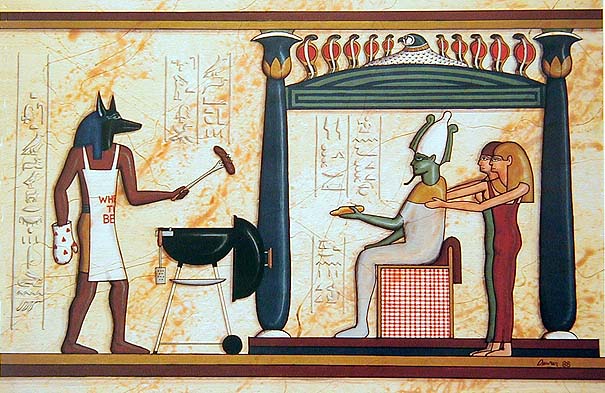


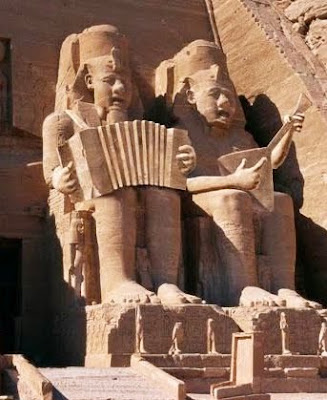
Thank you, thank you, I’ll be here all week! ;)
Last year’s second J post was on sacred jewelry.
KRT: Heka
This post is part of the Kemetic Round Table, which aims to answer some of the most common questions and provide a wealth of diverse options for the Kemetic novice to explore.
Today’s Kemetic Round Table post covers heka; specifically, what it is and how it is used.
I would like to, first and foremost, direct your attention to two exemplary posts: the first by Sarduriur as a general academic overview of what heka is (and is not), and the second by Saryt as an interpretation of heka applied to music. They are both stellar reads and speak volumes beyond what I will cover here.
Furthermore, since I’ve already written my take on the basics of heka, I would like to give some examples of heka, rather than restate myself or repeat portions of the aforelinked fantastic essays.
To sum up briefly: Heka is not magic as Westerners think of magic; it is authoritative utterance or meaningful speech, and it is a power that lies within every person and every Netjeru. Heka is a natural and neutral tool, neither innately positive or negative, and can be used to defend and attack as well as propitiate and strengthen. Heka was frequently used to identify oneself with different deities in order to assume Their characteristics (and powers) and can be akin to sympathetic magic in that regard; to speak (or scribe) is to make it so.
Now, let’s get to a couple of modern heka samples, shall we? They should illustrate just how simple and clear-cut heka can be; it’s not all fancy ceremonial litanies that take half an hour to recite! (Not to knock long-form heka, mind; it has its place, as do the briefer kinds.)
first heka: for migraines
I suffer from migraines, and while I have them in hand for the most part, they can still take me out at the kneecaps if I’m caught unawares. Because a migraine feels like my brain is unraveling in a rather painful and messy fashion, I liken it to uncreation, and I invoke the Eye of Ra Who has made me to protect me. (In my particular case, the Eye can be both Nebt-het (Nephthys), my divine Mother, and Sekhmet.) While this heka could also be done by my directly assuming the role of the Eye goddess, I am usually too swamped by the migraine symptoms to confidently pull that off.
This migraine seeks to uncreate me!
Its darkness is the darkness of Apep‘s coils;
its pain is the pain of Apep‘s teeth.
My Lady the Eye burns away the shadows;
She burns away the pain and cauterizes me.
My Lady the Eye has created me
and no force shall undo Her work in me.
second heka: for eye trouble
I wear contacts, and on rare occasion, I’ll get some little grain of grit sandwiched between a lens and my eye. It’s deeply uncomfortable and often sharply painful, and since I don’t currently have glasses of an appropriate Rx, I’m stuck hoping I can wash the offending particle out and put my contact right back in. Given that I’d be legally blind without contacts, it’s kind of vital that I be able to wear ’em, especially at work or while driving. I’ve used the below heka a couple times to considerable effect; the first two lines are paraphrased from an ancient prayer to Bast-Ra.
Turn to me, peace-loving Netjer, forgive me;
Make light for me so I can see Your beauty.
My eye is the eye of Heru that was wounded and made whole again.
third heka: job-hunting
This heka was made for my partner, the first part to be spoken before starting a job-hunting session (online or in person) and the second part to conclude that session. I involve Heru-wer only because He’s willing, but other deities could easily take His place if the need arose.
Heru-wer, accept this incense and grant me opportunity.
My eyes are Your eyes, my hands Your talons;
I will swoop down and seize success.
. . .
Thank You for Your long sight and swift wings, Heru.
May we enjoy victory together – nekhtet!
fourth heka: protection
This is part of a longer execration heka; I conclude the heka by invoking my personal Netjeru (plus Set) for protection.
Nebt-het watches over me,
Hethert-Nut uplifts me,
Ma’ahes guards me,
Serqet guides me.
Sekhmet is over me,
Set is behind me,
Netjer is around me.
I am safe from all isfet.
If you enjoyed this post, please check out the other takes on heka by my fellow Round Table bloggers!
PBP Fridays: J is for Black Jaguar Woman
 She was a shapeshifter: sometimes Jaguar Woman, sometimes fully jaguar—sometimes melanistic, sometimes golden and rosetted—usually female, but sometimes male. She smiled at me, indulgent, amused, lazily protective, as I in my youthful blundering looked to her as a guide and teacher. She led me through jungle, through journey, into the Underworld and back out again.
I called her Soul, because there was no better word that fit her.
She was one of my first and only personal allies, and the only who was more than the archetype and epitome of their species. She introduced me to shapeshifting, which was already my nature and then became my skill; she tolerated my inconsistent visits and humored me when I needed the reassurance. Her love was fierce, but she did not hold tightly—she accepted my company when I was there, but did not pull at me when I wasn’t. This is feline nature, I’ve found, and it is reflected in other feline entities I’ve encountered since.
When I broke, she found the pieces and brought them together again in me. I sang her a song for it, and years later, after I had stopped visiting the Otherworld, writing a song from what I imagined as her point of view was the first “real” song I would create, and the one that would break the dam that had kept me from creating my own music.
I imagine she’s still in her jungle, as flawless and richly-textured as she was a decade ago when I last saw her. Though there is no rhyme or litany I could sing her that would reach her without my delivering it in metaphysical person, unlike my Kemetic gods, I still have the urge to lay out offerings of honey and milk and berries in gratitude for all that she taught a much younger me.
Thank you, Soul.
Last year’s first J post was on journeying .
Black Cat, Red God
A gift for my sister, Saryt, of her Parents, Set and Bast.

a prayer for execution
According to the Kemetic Orthodox calendar, today, II Shomu 7, is the Day of the Executioners of Sekhmet. This holiday could be interpreted in a few ways, including a day to pacify Sekhmet and Her executioners (or plagues or vengeful netjeri (spirits)) or a day to honor Sekhmet’s physicians in their roles of executioners of illnesses and hurts. This prayer is to and for both.
. . .
Hail to you, Executioners!
Blades in hand, you sweep the earth
and cut into, cut apart, cut away.
Turn your faces towards isfet
and there direct your precision
and your sharpening hunger.
Devour that which harms,
excise that which uncreates,
and establish ma’at with your hands.
Sekhmet favors me,
so spare my healthy flesh
and attack only the shadows of sickness.
I praise your names
as you strike to bring balance
and unbloody Ma’at’s white feather.
Your knives separate hale from fel
and etch a line between strength and weakness
so we know where we must work hardest.
Today is your day, Executioners,
and I take up the knife with you
to expel isfet and preserve ma’at.
Dua Sekhmet, Who Wards Off All Evils!
PBP Fridays: I is for Ihy, The Musician
 I am writing this late, but yesterday was III Shomu 12, the day of Ihy’s birth… so it is not inappropriate that I catch up on this entry now. :)
Ihy is a child god, son of Hethert (Hathor) and Heru-wer (Horus the Elder), though He is occasionally described as being the son of other Netjeru. His name has been interpreted as “sistrum player” or “musician,” as well as “calf” (being that Hethert often took the form of a cow)—He is called the Bull of Confusion, the Lord of Hearts. He is the youthful patron or creator of music, the sistrum, and the jubilation that emanated from both sound and instrument. While He is primarily a joyful, musical god, He was also linked to the afterlife as “the lord of bread” and was “in charge of the beer,” a boon both for mortal offerings and the cyclical pacification of His mother in Her name of Sekhmet. He has also been linked, as other child gods were, to the blue lotus that represented renewal and birth and was called “the child who shines in the lotus.”
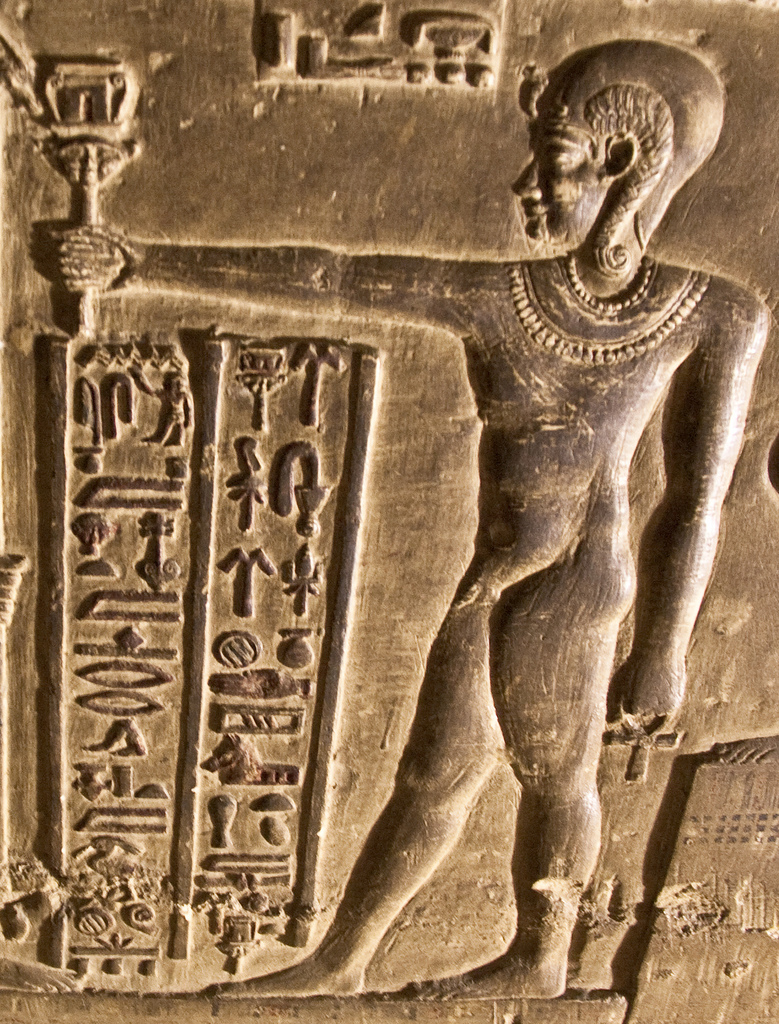
He was usually depicted nude, with the side-lock denoting youthfulness, often with a finger to His mouth; however, he was not always depicted as child-sized and was occasionally shown as large as adult Netjeru. To the right here, He’s shown wearing a uraeus and holding a sistrum decorated with His mother’s face. In some birth houses, He was equated with the king, and scenes celebrated the conception and birth of the divine child, which identified the king with Ihy and bestowed upon him the powers and protections of the child god Himself.
Spell 334 describes His birth:
My awesomeness precedes me
As Ihy, the Son of Hathor,
I am he who begets a begetting,
I flowed out from between her thighs,
In this my name Jackal of the Light,
I broke forth from the egg…
I escaped in her blood,
I am the Lord of blood. I am a turbulent bull…
I came into being, I crept, I traveled around.
I grew, I became tall like my father
In the Coffin Texts, Ihy’s resemblance to His mother Hethert is described:
My perfume is the incense
which my mother Hathor uses for her censing,
My efflux is the sacred oil
which my mother Hathor uses for her flesh…
My intestines are the beads of her menat
which my mother Hathor places at her throat,
And my hands are her sistrum
which my mother Hathor
Uses for her contentment.
And, for His (one day belated) birthday, a modern offering:
A song for You, O Ihy,
most musical of all Netjeru!
A song for You and a song for me,
that we may sing together!
As You shake the sistrum for Your mother
that She may be made glad,
so I shake the sistrum for You
that You may share in my joy!
A song for us, O Ihy,
to exult and celebrate life!
Sources:
- Egyptian Mythology (Geraldine Pinch)
- The Complete Gods and Goddesses of Ancient Egypt (Richard Wilkinson)
- The Routledge Dictionary of Egyptian Gods and Goddesses (George Hart)
- Hathor Rising (Alison Roberts)
Last year’s second I post was on isfet.
 1 Comment »
KRT: Crafting the Kemetic Community
This post is part of the Kemetic Round Table, which aims to answer some of the most common questions and provide a wealth of diverse options for the Kemetic novice to explore.
There are an awful lot of components to this particular KRT prompt, but I’d like to focus on just one facet: what we as individual Kemetics, whether or not we’re currently part of a Kemetic group, can do to create and improve the Kemetic community as a whole. There are plenty of posts that cover the other sub-topics of community flaws and how to bridge the gaps, but I much prefer to focus on concrete, proactive options that a single person can undertake. After all, while there are some larger Kemetic organizations, plenty of folks are either operating solitaries or outreachers beyond the communal house of their fellows.
As a moment of personal background, which will give perspective to this post: I am a Shemsu (“follower”) within Kemetic Orthodoxy and have been a part of this community for about two years now. For five or six years before that, I was a solitary and eclectic devotee of Sekhmet. Even now, digitally immersed in a community that I adore and with friends and peers unaffiliated with that community, I have no Kemetics within a four-hour radius of my home, so in that sense, I am still a practicing solitary. I suspect that many Kemetics share my situation: plenty of online camaraderie, but no face-to-face kindred, at least not on a casual daily basis.
So, then, the question: how do we build a community and improve the community/ies that we’ve got?
First, I think, we must acknowledge that community was a cornerstone of ancient Egyptian life and, in most cases, still quite important in modern Kemeticism. Secondly, we must acknowledge that community is not just our particular group of Kemetics, if we have one such group at all; if I am Kemetic, if I exist within a community at all—and I do—then that community goes beyond Kemetic Orthodoxy and into the wider realm of all-stripes Kemetics. And, of course, within a large enough collection of beautifully human, beautifully individualistic, and beautifully imperfect people, one will see disagreements, clashes, and differences of opinion.
But family is family, and howevermuch one might roll one’s eyes at one’s kooky uncle or crass aunt, they are still part of the tribe that we protect and support. This is community, and it is built one person at a time, a garden planted seed-by-seed. We build community one handshake after another, one hello and then another. It is this community that, when healthy and vibrant and living, will care for us just as we tend to it.
The heart of any community is the individual, and to better the Kemetic community, my best and only advice is to heal thyself, physician. Your heart and your spirit thrive within your personal practice, and your first duty is to yourself and your gods. By taking care of yourself, by tending to your gods and your relationship to Netjer, you bring ma’at into the world, and you contribute to a resilient foundation within our community. Your health and your actions radiate outwards and influence the other Kemetics that you know, just as they affect you, and this feedback cycle is strengthened and made pure by your own strength and purity.
And so it goes, so it grows, ever outwards. To create community, we reach out our hands to touch others; we speak with honesty, with respect, and with the understanding that no two Kemetics are the same, so your practice will not be what another does. To improve community, we reach out our hands to Netjer; we worship with honesty, with respect, and with the understanding that no two Kemetics are the same, so your practice is unique and invaluable to Netjer.
To begin a journey, you must take a step; to build upon it, you must keep taking steps, but only ever one at a time. So it is with community: start with one kindred spirit, and continue reaching out until you weave yourself into the rich tapestry that this living faith and its diverse, brilliant, strong-willed practitioners have begun to co-create.
If you enjoyed this post, please check out the other takes on how to deal with contributing to our Kemetic community by my fellow Round Table bloggers!

