
forms of devotion
I am devoted to my gods. Except I’m not sure I can say that truthfully, because I’ve never explored in-depth what “devotion” means to me, what forms it takes, and so I can’t know whether or not I’m devoted.
If I were a bettin’ man, I’d reckon that devotion can be boiled down to giving one’s time, attention, and energy to something. No monetary contribution can make or break devotion; no physical object can, either. I can be devoted without a penny or statue to my name; I can have all the money and icons in the world without being devoted.
But time, and attention, and energy – those are things pretty much everyone has, in whatever quantity and quality. If I’m the uber-busy parent of three young children and CEO of a start-up company, my giving five minutes a day is going to mean a whole hell of a lot; if I’m working part-time and chillin’ out, enjoying life, then maybe five minutes isn’t going to cut it. Devotion is, in my eyes, something that adjusts to fit each individual. Likewise with energy and attention – some people do not have the physical or mental capacity to give as much energy and focus as others, and that’s totally okay. Devotion should be a subjective, personal standard. (I acknowledge that, many times, Netjer will request a certain standard of us, but for the sake of this post, I’m only exploring self-set expectations. I can’t predict what the gods will want of me, after all!)
So, what’s my standard for myself?
I practice mindfulness, so staying mindful of my gods is part and parcel of it. Remembering what They would like from me, what They expect from me, and how I might be able to include Them in my life. I am not terribly ceremonial, so I’m not going to hold myself to an unrealistic standard of performing ritual or senut X times a week. I value spontaneity and flowing with the moment, so any given standard of doing something a number of times per week or month is likely going to feel forced– but if I lack a guideline, I may well wind up doing too little for my own tastes.
I work a demanding web job, and I deal with migraines, and I find I lose one or two days a week to something or other that’s less than voluntary and ideal– so is it unrealistic or just optimistic to think I might be able to “touch base” with each of my gods, my Mothers and my Beloveds, once a week at minimum? If I keep myself flexible, I think it might work out quite well.
My devotion takes many forms, all of them valid in my eyes. If I spend time maintaining this website, writing in this blog, and researching the Netjeru I honor, that’s still giving my time, energy, and attention to Them, either directly or indirectly. If I keep my virtual space as clean as my altar, keep everything well-organized so that the energy flows, that counts, too. I don’t have to be in front of my shrine or in deep trance to experience and honor Them, and I need to keep that in mind, ’cause it’s pretty easy for me to think I can only talk to Them in certain places, under certain circumstances. But They’re everywhere, and that’s why I wear jewelry for each of Them daily – to be able to touch Their symbols and reconnect with Them throughout the day.
There are always plenty of ways I can interact with Netjer. Physical exertion, be it exercise or martial arts, is my tribute to Sekhmet. Spending time breathing the wind outside and watching the clouds or stars is a way to be closer to my Mothers. Stepping outside at sunset to honor Ma’ahes is a wonderful respite from the daily grind. A simple prayer – be it a written letter to a god or a spoken refrain while I drive to work – grounds me in mindfulness and gratitude. And of course, any creativity worked in Their names – painting or beading or sculpeying or musicking – is one of my favorite ways to bring me close to Them and to offer the best of my hands and heart to Them.
I love my gods, and I would like to count myself as devoted, so I will keep taking small, sustainable steps to see and honor Them in my life.
Dua Netjer!
Now on WordPress! Ooh, shiny.
So, after some contemplation, I have decided to have a WordPress blog in addition to my Dreamwidth journal. I will crosspost all WP entries over to Emky for the ease of those who prefer DW to WP, and I may still use DW to post more informal and personal friends-locked entries. You’ll be able to comment here or there, whichever pleases you. Mostly, for those who dig WP, I’m here and followable now. :D
PBP Fridays: J is for Sacred Jewelry
(I know I’ve missed like three posts, but I’m going to hop in here and make up for the others later. :D)
I have talked about writing music and painting with and for gods before, but at the time, I had never set foot in the seductive manse of beadwork. I think it’s definitely time for me to discuss making sacred jewelry with and for my beloved Netjeru (Egyptian deities).
Myself, I adore the concept of religious and/or spiritual jewelry, especially of the daily-wear variety. I like having something on me to touch and see that reminds me of and connects me with my gods (or a particular ideal or myth or animal or… you get the point). My love gave me a necklace he made and had worn for years before we met, and I wear it every day; it’s a link to him and a representation of us together.

Currently, I also wear a silver lion’s-head ring (for Ma’ahes) every day, a single amethyst earring (for Nebt-het), and most days, either my scorpion talisman or the new scorpion necklace (for Serqet), as well as a pewter Sekhmet pendant. My sacred jewelry is very important to me, and so, it’s not a huge surprise that, once I figured out I might actually be able to craft things that did not look like a middle-schooler made them at summer camp, I wanted to make jewelry for my gods.
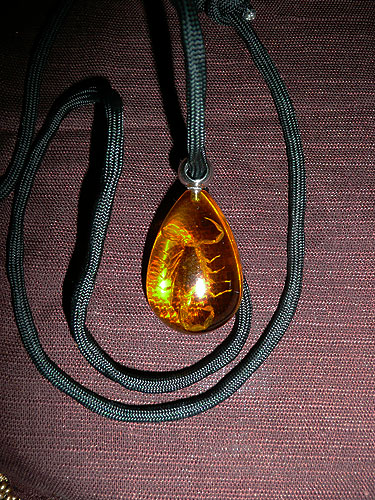
To date, I have made six pieces of a spiritual bend:

And I’ve got to say, this is really addictive, guys.
Much like writing a song or doing a painting for a deity, I get the same intuitive nudges on what fits and what doesn’t, the same instinctive yes/no reaction when I ask a question of “want this?” or “how about this?” that helps me flesh out and finish a piece. I have gone shopping in our local bead store and sent out an open invitation to my gods to let me know if They spot something They’d like. It’s an amazing and admittedly strange sensation, to know that I’ll get a very firm answer without having to trance, meditate, or be in ritual space. I couldn’t explain it if I tried, but I can’t complain: so far it’s resulted in a well-received finished piece of jewelry every time!
For my newfound love of beading, and also my slightly-less-new-but-still-immense love of paintings, I decided to open a wee Etsy shoppe to sell sigils, mythological paintings, and hand-made jewelry. My lovely partner, who has been making jewelry for far longer than I, has also contributed his time and craft to the somewhat thrilling project that we’re calling Mythic Curios. I even made a small website to explain the process of making the sigils and the magic behind them. Right now, my favorite part of that site is our Curio Archive, which has a running photographic list of all of our projects, including the ones that won’t appear on Etsy (such as personal projects and gifts).
I can’t wait for Mythic Curios to become a little more well-known – I’m really looking forward to folks wanting custom pieces for their specific gods (or just themselves!), because I adore making items to request! It’s a challenge and an adventure and a chance for me to interact with a new deity– or one I already know in a new way.
To encourage some conversation here, tell me about your own crafting or wearing of spiritual or otherwise meaningful jewelry! I’d love to hear stories and see photos if you’ve got ’em. :)
This post brought to you as part of the Pagan Blog Project.
Mother’s Day
To my Lady Mother, Nebt-het, Who fashioned my soul,
and to Mama Hethert-Nut, Who also fashioned my soul,
and to my mom, who created my body from her own,
and to my partner’s mom, who welcomed me into her family,
and to all the mothers of my blood, stretching back in time:
Thank you for my life and your love. I love you.

PBP Fridays: J is for Journeying
Plenty of folks have done this topic for the Pagan Blog Project, but I don’t mention journeying very much on this blog, so it’s worth writing about for me.
I journey, or pathwork, whichever term you prefer; I use both. To journey, for me, means to send my consciousness outside of my physical body and into a spiritual and/or metaphysical location; going to the Otherworld, seeing the Unseen, that’s journeying. (I use the incredibly scientific and technical term of “throwing” for when I’m sending my awareness to visit a place in the physical realm; pretty sure others refer to this as remote viewing.)
I don’t claim to know or even guess at how this works in scientific or spiritual terms, and the “how” doesn’t really matter to me. I may be playing pretend, I may be venturing through the astral realm, I may be inducing minor neurological hallucinations, I may be engaging with various psychological archetypes of my conscious and subconscious, or maybe some combination of the above. What matters to me is that journeying has a positive, beneficial, tangible effect on my own person and practices, and it doesn’t bring any detriment to me, and so I continue on my merry way. :)
When I was wee, or at least more wee than I am now, I got my hands on some Wiccan books, an astral projection how-to guide, and Michael Harner’s Way of the Shaman. I never got the hang of astral projection; I was always too aware of my physical body to make that separation, which is how “throwing” came about in its stead. But I learned different techniques for going to different non-physical “places,” and for a while there, I did so regularly as an accompaniment to my totemism practice, experimenting with more traditional forms of journeying with the aid of drums and more neo-pagan forms of journeying that were reminiscent of creative visualization.
I don’t journey so much anymore; my studies in Kemeticism have taken me more towards the in-person ritual than the in-spirit pathworking. But it still feels like a core piece of my spirituality practice and my magical toolkit, and I look forward to the time that feels right for me to return to journeying on a regular basis.
This post brought to you as part of the Pagan Blog Project.
necklaces for Ma’ahes and Serqet!
Guys, this whole making-jewelry thing is kind of addictive. Just sayin’.
Necklace for Ma’ahes, the Living Lion, with a nod towards His Nubian Name of Apedemak:
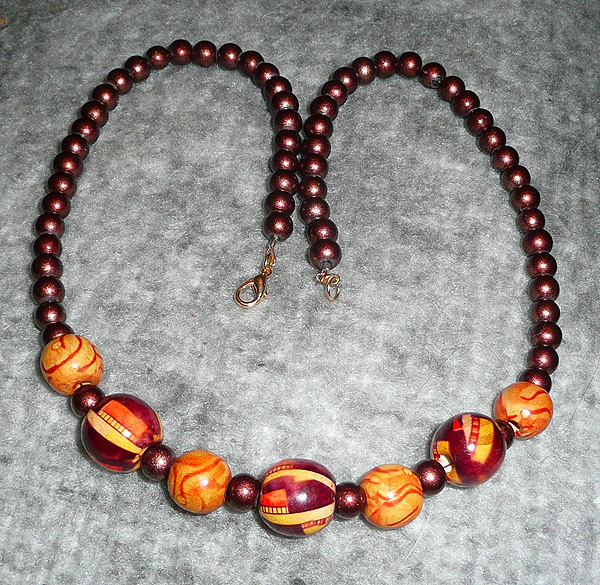
Necklace for Serqet, Our Lady of Scorpions:

Dua Ma’ahes! Dua Serqet!
PBP Fridays: I is for Isfet
Isfet is a concept found in ancient Egypt (and in modern Kemetic practices), and it has no direct perfect translation to English. It is the opposite of ma’at, which is rightness and truth, harmony and balance; so isfet can be called wrongness and falseness, disharmony and imbalance. Isfet could be called evil, or chaos, but neither is quite right. It is subtler than “evil,” I think, and is perhaps the closest thing that Kemetics have to “sin.” If one makes a mistake that hurts another person, it is not isfet; to deliberately choose to go against ma’at and bring about harm is isfet.
One of ancient Egypt’s creation myths – the one featuring Nit (Neith) as the Creatrix – states that isfet, in the form of Ap-p the Uncreated (Apophis), came into being while Nit was creating the world. While She spoke life into existence, a drop of spittle fell from Her mouth; it was part of the power of creation, yet without purpose or form. It has attempted to undo creation ever since, a sign that sometimes things happen which even the gods don’t intend.
Isfet itself is a term that refers to the doings of the Uncreated and how they are expressed in the world. Isfet is the concept; gereg is lying (speaking isfet), and binet is akin to oppressing or harming (performing or acting on isfet).
As a Kemetic, I strive to bring ma’at to the world through my words, actions, and heart; likewise, I strive to minimize and extinguish isfet from my person and my life. Much like any standard of purity, it is a constant effort to promote ma’at; however, since isfet is never accidental and always deliberate, I find it much more cleanly-cut to measure against my own standards. For example, I may be having a terrible day and be struggling to be as strong in ma’at as I would like, but I can at least work to curb my tongue and not strike out at others in frustration and pain, and therefore I can avoid creating isfet in that moment.
In Egyptian mythology, fighting the Uncreated is the work of many gods, the strongest of which is Set; but other gods have given humans heka (magic) in order to battle and defeat isfet in our mortal lives. We are not unarmed; we can always strive to lessen the power of the wrongness that crops up in the world. Each day is a new opportunity to rise above isfet and protect each other from harm.
This post brought to you as part of the Pagan Blog Project.
another shiny for Hethert-Nut
So, I don’t bead, right, but I sort of beaded, and this happened, and I pretty much adore it:
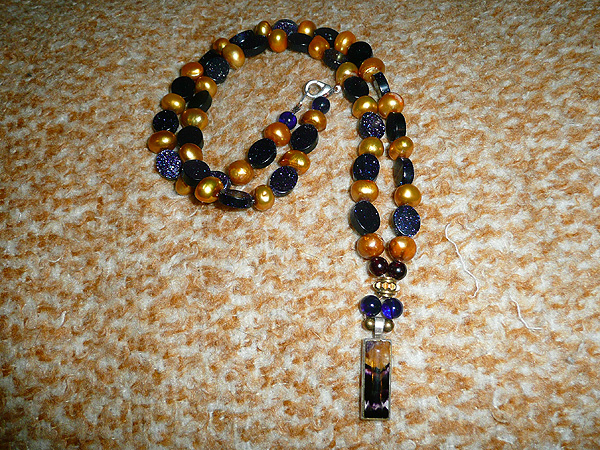
It’s for Hethert-Nut, the Gold of the Gods, the Starry Sky. The pendant is Blue John, a special kind of fluorite only found in Derbyshire in the UK, and was a gift from British friends years ago.
As a result of this necklace, I think I’ll be trying my hand at a lot more jewelry… =3
Dua Hethert-Nut!
Announcing Mythic Curios!
My partner and I were struck by an idea on April’s Friday the 13th and, enthusiastically driven to act on it for some clearly unknowable reason (ahem), I built a web presence around it that very evening. We spent the next couple weeks fleshing it out and crafting, and well, it’s about due time I share it here, since the news has officially gotten out. :D
Allow me to introduce to you Mythic Curios, an online shoppe featuring custom magic sigils, fantastical jewelry, and mythological paintings by yours truly and the brilliant love of my life! We even put together a small website to explore the idea of paying for magic and the kinds of magic that we use in the sigils and some paintings – because, you know, it’s sort of important to know what’s going on behind the Seen when messing with magical objects.
I am really excited about this project and very proud of the work we’re doing. This is not an attempt to build a livelihood – our prices are way too low for that! It’s a way to share something we absolutely love to create and look at and wear, a way to help people by bringing magic and unique beauty into their lives, and also a way to fund future creations so we don’t eat ramen in the name of buying more beads and acrylics. (Because, seriously, we would. Art trumps fine food!)
If you’re at all interested in magical art or handmade jewelry, please do peruse the curio archive and spread the word to others who might like it! And, of course, we’d love the chance to make you your own painting or piece of jewelry. :)
 No Comments »
PBP Fridays: I is for Immanence
I believe in immanence.
Immanence, or in-dwelling, indicates that the Divine resides within, not (solely) without. I have the spark of divinity within my body, heart, mind; so does every other person alive, dead, or yet to be born. For myself, I also believe that every bodiless spirit and every inanimate object is also part of the Divine. We’re all ingredients in the great gumbo of God. :) I am different from my chair* and from my grandmother who has passed on, but I am no more or less sacred than either, no more or less part of the universe and so the Universal Soul.
(*Why yes, I am frequently guilty of anthropomorphizing objects; you should listen to how I talk to my car. However, that’s one of those personal quirks that has only positive ramifications and no negative side-effects, so I happily and freely continue. I break fewer things this way, that’s for sure.)
This belief– this connectedness, this kinship– is one of the many reasons I practice compassion and study zen. The more gently, kindly, courteously I can treat the world – including myself – the better the world is, in however small a way. The more I can see from another’s view and understand them, the less I judge and the more acceptance I bring to the world. The more connected to the Universe that I feel, the less personally I take negative words, actions, and events.
To put it slightly more practically: Shit happens, and it ain’t about me. It may be about something I said, or did, but my actions or words are not the sole constituents of the person who is me. And when I remember that and reflect that as a two-way philosophy, well, I can engage with people with much more compassion than if I feel like someone did something just to hurt me– or if I feel my mistake was somehow aimed like an arrow at someone else’s heart.
The connection between compassion and immanence may not be obvious, or even sensical, but it’s a necessary bridge in my own eyes. Everything, and everyone, is part of the Divine; everything, and everyone, deserves to be treated with as much compassion and gentleness as I can muster.
This post brought to you as part of the Pagan Blog Project.
PBP Fridays: H is for Hethert-Nut, Egypt’s Celestial Cow
This post has become a permanent page on this site here!
This post brought to you as part of the Pagan Blog Project.
No Comments »
PBP Fridays: H is for Heka, Egyptian Magic
The Kemetic (ancient Egyptian) word heka is most frequently translated to be “magic,” but it’s not quite the kind of magic that most of us in the Western world are familiar with. Heka is word-magic, the power inherent in the written or spoken word, the power of authoritative utterance. It most literally translates to “activating the ka,” which is the part of one’s being or spirit that comprises one’s current personality and psyche; the power of heka is tied to the soul and the innate power of who we are. Unlike a lot of modern magical methods, heka does not require casting circle, creating sacred space, raising or channeling energy, or invoking any entities into your personal space. Heka is language at its most powerful, and as language, prayers can be heka just as easily as “spells” can be heka.
Ancient Egyptians and many modern Kemetics place special emphasis on how they speak and what they say (or write). Heka is in every word that passes our lips and hands, not just the words we intend to be magical or prayerful. As I write this entry, I commit heka. As I pray to my gods and sing Them songs, I engage with heka. As I write my little charms in Kalash on the whiteboards at work, I inscribe heka. As I hold a conversation about silly things or deep things with my friends, coworkers, and myself, I create heka.
One of the things I love about the power of heka is that its strength and effectiveness is solidly backed by science. The power of what we say and how we say it has been extensively studied from almost every point of view, from hard psychology to self-help authors to New Age affirmation gurus to modern magicians. There’s a huge difference in how our bodies and brain chemicals and intangible minds react to “I won’t smoke anymore” vs. “I want to quit smoking” vs. “I am quitting smoking” (or “I quit smoking”).
Heka is the understanding that what you say matters. Ancient Egyptians often offered teaching wisdoms to this point: speak only in surety, do not speak out of anger, holding your tongue is to be the bigger person. The value in speaking with care and deliberation has not lessened as the ages have worn on; as a point of self-control, as part of compassionate interaction, heka has a crucial role to play in how we communicate with others and express ourselves.
Not to mention the power of intentional heka used in prayer and magic! To focus all the power of language into short forms of prayer or ritual or spellwork, written or spoken, is an amazing thing. It’s like poetry, like music, able to distill the immensity of the human experience – or at least one facet of it – down to a singular, streaming flow of words. One can bring to bear all the power of linguistic aesthetics and magical potential, calling on positive phrases and avoiding negative ones, choosing particular words for their beauty and their acute meanings. To craft heka as prayer or spell, written or spoken, is to forge a blade and hone it to a glistening, unwavering edge. With intentional heka, one etches oneself upon the slate of the universe, for good or ill, in the name of willful change or gratitude or whatever one sees fit. We can change the world – the big one outside and the smaller ones inside ourselves – with the shapes of our tongues and teeth and ink-bearing hands.
Heka can come in many forms and trappings, including those we more commonly associate with ritual – light the candle, light the incense, say the words of purification, wash, say the words of prayer or of spellwork, and even add raised energy to the mix. Ancient Egyptians so believed in the power of heka that many of their spells and rituals involved taking on a particular god’s name – and thus, all powers and relationships S/He had – in order to accomplish a goal. At its heart, heka is the power of the language we choose and use. Our words have power, and we are responsible for how that power is dispensed through our vocabulary.
This post brought to you as part of the Pagan Blog Project.
a short akhu prayer
I say this while pouring a libation of water for my ancestors, then lighting a white candle. The words are inspired by and in small parts taken from a beautiful Kemetic Orthodoxy rite that’s performed every month for the blessed dead.
…
Hail akhu, known and unknown, true of voice, shining as stars in the vault of Nut! I offer to you cool water and a thousand of all good and pure things.
May you go outdoors every morning and return every evening, in all the forms you wish to assume. May you enter this, your house of the living, in joy; I bid you welcome and burn a candle for you here.
Dua akhu!

