
Archive for the ‘Information & Research’ Category
tyet
From Reading Egyptian Art by Wilkinson, around p. 201:
In the Late Period, the tyet was associated with the goddesses Nut, Hethert and Nebthet.
HELLO ALL MY MOTHERS

The Book of the Celestial Cow
… which is apparently the primary resource on Hethert-Nut. So I’ve ordered a book by Erik Hornung which should have a solid chunk of information about it.
For now, I get, from here (which I do not claim to be correct; I am doing preliminary research here):
“It is my mother the Great Wild Cow, long of plumes, bright of head-cloth, pendulous of breasts, who has lifted me up to the sky, not having left me on Earth, among the gods who have power.”
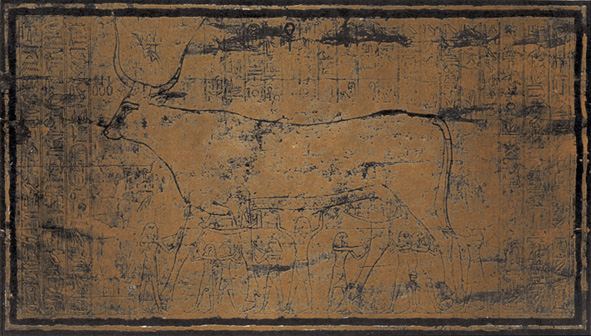
Part 3 : The Heavenly Cow:
This spell is to be recited over the (picture of) a cow, with “the Infinite Ones who are” (inscribed) on her chest, and over whose back is (inscribed) “the Infinite Ones who are”. Whose four hoofs are filled out in paint and upon whose belly are nine stars, issuing from its hindquarters in front of its hind legs, while beneath its belly stands Shu, painted in yellow ocher, his arms support these stars, and inscribed with his name between them, which says “Shu is himself”.
A barque, on which are a steering-oar and a shrine with a Solar disk over it and Re in it, is in front of Shu, close to his hand, while another version (of a barque) is behind him, close to his (other) hand. Her two udders are placed in the middle of her left leg, one half of them being drawn in paint in the middle of this hind leg with the following words outside in retrograde : “I am who I am. I will not let them take action.” What is (written) beneath the barque that is in front is : “You shall not grow weary, my son.” – in retrograde, and as follows : “Your condition is like that of one who lives forever.” and as follows : “Your son is in me. Life, prosperity and health be for your nose!”
What is (written) behind Shu, close to his arm, is as follows: “Guard them !” What is behind him at his flank is (written) in retrograde as follows : “It is right that they should enter when I retire each day.” What is (written) under the arm of the figure below the left hind leg and behind it is as follows : “Everything is sealed.” What is (written) above his head, below the hindquarters of the cow and what is between its hind legs is as follows: “May he come out.” What is (written) behind the two figures that are between its hind legs and above their heads: “The aged one is in the realm of the dead. Praise is given to him when he enters.” What is (written) over the heads of the two figures that are between its forelegs: “He who procreates, he who adores, support of the sky.”
Third Spell: Hymn to Nut
A magician, his head being purified, should make a female figure, standing to his South, and draw a goddess upon her, and in the middle of her, a snake standing erect upon its tail, with her hand upon its body and its tail upon the ground.
(He should say):
“O You, to whom Thoth gives praise, while the dignity of heaven is upon You and toward whom Shu extends his arms, may You save me from those two great and mighty gods who dwell in the East of the sky, who guard heaven, who guard Earth, and who are with enduring mysteries.”Then they must say:
“How great he is when he goes forth to see Nun!”
Unrelated to Hethert-Nut, but of interest to me, Ra speaking to Geb:
“Take heed of your snakes which are in You! Behold, they feared me as long as I was there, but You know their magical power. Go then to the place where my father Nun is and tell him to keep watch over terrestrial and aquatic snakes. You are to write down each mound belonging to the snakes there, saying: ‘Beware of spoiling anything!’ They should know that I am here, for I am shining for them too. Now as for their habitation, it will exist in this land forever.”
edit to add:
Oh oh, actual translations here!
22 October – III Akhet 21
Day of Renenutet and Nit
From the Pyramid Texts, Utterance 340:
“I have come to You, Old One; may You turn back to me as the east wind is turned back behind the west wind; may You come to me as the north wind comes after the south wind.”
so about them thar sphinxes
I have been wanting a $100+ book about Twtw (Tutu/Tithoes) for about a year now, give or take. I have been lusting after it. It is the book on Twtw, an entity I find endlessly fascinating and compelling.
And with his first paycheck, J performed a book tithe and gifted me this book. It arrived today.
And then I arted. Fourth painting, and you know? It came out how I intended. I’m happy. Click through to see a larger version!

Okay so I’m actually giddy and hyper-excited about the book+painting+squee, so uh, “happy” might be an understatement.
(And if you were wondering, yes, that picture was taken with everything resting on a djembe. Also, the background is way more subtle in person, and the outline is in silver, not white.)
 No Comments »
I don’t believe in coincidence.
Serqet
– Serqet is a scorpion goddess. She is both protector (with Her stings and from them) and healer (of Her own poison). She is associated with the most deadly scorpions in Egypt.
– Because I fucking love scorpions, I took an interest in Serqet. Because I have a vested personal concern in removing poisons from my life and protecting myself from any future poisons, I took a keen interest in Her.
– On the move to Texas, we stopped at a gas station selling random novelty items. I found a variety of scorpion keychains of varying colors and scorpion species/subspecies. I was unable to choose anything but this one, a yellow scorpion in amber resin, with long and thin (instead of blocky and strong) pincers. J made me a lanyard necklace for it, as you see in the photo.
– I wrote the prayer to Serqet and have been wearing the necklace. I remind myself of it, and Her, when I feel like I am succumbing to (emotional, mental) poisons.
– I decided to find out which scorpions are in Egypt. I found out about the Deathstalker scorpion. In order to make an icon for Serqet, I looked up photos of this scorpion.
– I came across this, which looks pretty much exactly like the scorpion in my necklace, barring the obvious size difference.

– I figured I’m doin’ something right. :D
…
Renenutet
– Renenutet is a cobra goddess of abundance. She is a divine nurse (but not child-bearer Herself) and is said to protect both the pharaoh and the crops, both in the field pre-harvest and in the granaries afterwards, because cobras eat the vermin that would eat the crops.
– I have an amazingly strong draw towards Renenutet and a powerful, almost tangible sensory impression of Her. (This has to do with synesthesia, so my feeling of Her translates in weird ways.) The most overwhelming association with Her for me is the color of wheat and barley and indirect sunlight. Every time I think of Her, that color invades the space around me like someone dyed the air yellow.
– I decided to find out which cobras are in Egypt. Unsurprisingly, I found out about the Egyptian cobra. In order to make an icon for Renenutet, I looked up photos of this snake. (Sound familiar?)
– I came across this, the banded Egyptian cobra. The golden color is the exact color that I keep seeing/feeling when I think of Renenutet.

– As a bonus, my long-time self-image of myself as a Korat, my favorite fictional species of mine, is evenly striped with black and, you guessed it, pretty much that exact shade of gold. See? (Apologies for the ancient art and bad scan.)

– I figured I’m doin’ something right. XD
have some gleeful babbling
So, to some/most people, my sudden obsessive interest in Kemeticism is probably a surprise. And since the whole package deal fills me with happy wriggles and excitement and connection, I might as well ramble and explain some of it! At least the basics, right?
First, some pertinent links:
– About Kemetic Orthodoxy
– About the creator and leader of Kemetic Orthodoxy
– Kemetic Orthodoxy forums aka the House of Netjer (I’m Emky on all forums)
– Kemetic Interfaith Network forums (a place for all Kemetics, not just Kemetic Orthodoxy, to come together and talk and socialize and share and learn)
And pertinent terms (put into my own words):
– Netjer = the Universal Soul, the divinity and life-force within all things (also: godhead, the Source, etc)
– Netjeru / Names = Netjer pluralized, the forms that Netjer takes, gods
Years ago, I came up with a diamond metaphor to explain how I view the Universal Soul and gods/archetypes. To my shock, I found the exact same metaphor used, entirely independently of me, in the teaching materials of the beginner course. Basically, if one considers Netjer/the Universal Soul/the Great Spirit/God/etc as an infinitely faceted diamond, so huge and shining as to be incomprehensible by the human mind in Its whole, then each facet – distinct, individual-yet-connected – is a Netjeru/god/archetype/etc. And each facet can be further faceted down (for example, Sekhmet-as-destroyer and Sekhmet-as-healer), even going so far as to get completely subjective views (Sekhmet-as-She-appears-to-me). That’s what monolatry is, somewhere along the spectrum of hard and soft polytheism, and that’s the Kemetic Orthodoxy view. Which, apparently, I adopted before I even knew about the religion. :D
– ma’at = the concept of rightness, justice, truth, and order; not exactly “good” (similar to Tao but not the same)
– isfet = bad shit, anti-ma’at; the concept of wrongness, chaos; not exactly “evil” (similar to sin but not the same)
– heka = authoritative utterance; spoken or written magic
– henu = a physical gesture of deep respect and praise, often phrased as “offers henu”; see illustration, can also be done with forearms/hands/forehead pressed to floor in a kneeling position
– nekhtet! = “victory”, used when one might say “huzzah!” or “booyah!”
– dua = praise/hail, phrased as “Dua [deity]!”
– the Duat = the Unseen world; the horizon
– Hemet / the Nisut = the leader of Kemetic Orthodoxy
– Wep Ronpet = Kemetic new year, based on the rising of Sirius over the horizon (and thus close to the inundation)
– em hotep = “in peace”, a Kemetic greeting
– ka = part of the human soul that is the psyche/personality of the current incarnation; one’s essence, which one can feed/nourish by doing awesome things for oneself; this is the bit that gets venerated as an ancestor after death
– ba = the eternal part of the human soul, that which outlasts the body’s death; this is the bit that reincarnates or resides forever after with Netjer
– Remetj = “the people”, friends of the faith, folks who participate in and follow the tenets of Kemetic Orthodoxy but have not committed to it as their foremost path
– Shemsu = devotees, those who have sworn to uphold Kemetic tenets and honor Kemetic deities before all others (but are still totally allowed to have other practices/worship non-Kemetic gods, which is awesome)

I don’t expect anyone to remember all of this, of course, but I figured an entry to reference might help the unfamiliar when I drop a term and forget to define it afterwards. ^^;
To sum up the path that led me to Kemetic Orthodoxy… In 2005, I initiated a relationship with Sekhmet; for a lot of reasons at the time, I needed Her. For the first couple years, it was a request-based relationship, but we got much tighter when She requested that I study Egyptian religion and mythology. (I had protested that I was no good with ceremonialism, but She wanted me to know as much as I could so that I could blend Her culture with my own organic spirituality as well as possible. I figured it was a fair compromise. Knowledge can’t hurt, right?) I did an initial round of study, deepened my devotion to Her, and this year, came into the urge/calling for another round of more in-depth study.
As a part of that study, I took the beginner course offered by Kemetic Orthodoxy, acquired like ten new books (with so many more on the wishlist…), and found people I respect and adore in the community. Turns out that (this brand of) Kemeticism is not nearly so ceremonial-magicky as I thought; some state practices are formal, but most personal practice is spontaneous and/or flexible. I never really thought I’d find a spiritual community that resonated well with me, that so supported individual experiences and subjective differences and tolerance, but I have, and I love it dearly. Also, for the first time in many a year, I feel drawn towards deities other than Sekhmet, which is amazing and a little nervous-making, but I’m eager to explore. Hell, I’m even wanting to turn this ravenous appetite for knowledge-experience back on Celtic mythology, which I never realized felt like home turf until I ventured back into the green.
I am just… utterly amazed by the vibe the Kemetic Orthodoxy community gives off. It’s like basking in sunlight, wanting to roll around to absorb every last bit of warmth and brilliance. These people aren’t just devoted to what they believe, they aren’t just worshipping and taking joy in their gods, they’re learning and studying and debating and doing. They fuse mind and spirit, body and word. The primary personal rite, Senut, even has suggested maximums of typical time spent in it because one should be out living this life they’re celebrating, not staying in shrine dawn to dusk. (Uh, priests have slightly different expectations, of course, but the emphasis on Living Life remains.) That’s so cool to me. And, while Kemetic Orthodoxy does have certain tenets central to the faith, they aren’t The Only Way. It may be the Kemetic Orthodoxy way, but if you don’t jive with that, if you don’t believe it or practice it, no problem – it doesn’t make you wrong, even though it may make you not-Kemetic-Orthodox. Tolerance for the win!
And yes, everything about Kemetic Orthodoxy and the friends I have made within it is infused with NRE (new relationship energy; the buzz, the dazzle, the endorphin glow). I am excited and giddy about my fellow beginners, about the upcoming graduation process that will see us offered a place within the religion as either Remetj (see aforementioned terminology list) or Shemsu, depending on where we want to be and the level of commitment we wish. I want to keep challenging myself to learn more, experience more, and do more. It’s an amazing, eye-opening thing, and since my core beliefs and worldview parallel or overlap the Kemetic Orthodoxy tenets, I can stay true to myself while engaging fully.
tl;dr version: Kemetic Orthodoxy is crazy-awesome and jives with me really well and I’m super-happy with it. :D

