 June 9th, 2010
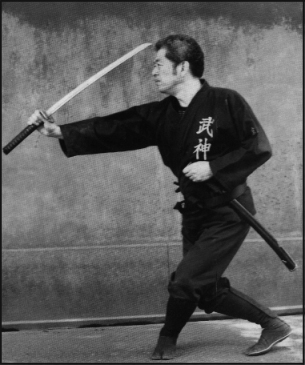
We start each martial arts class by saying shikin haramitsu daikomyo. My favorite translation of that is in every encounter lies the opportunity for enlightenment. There is a potential revelation in every moment, in every interaction, in every breath you take.
This March, I had the pleasure of attending the 2010 IBDA Tai Kai, a forty-person, three-day, intensive training camp for those teaching and studying Bujinkan ninjutsu, hosted by Shihan Van Donk in San Francisco. I hoped for the Tai Kai to hold a little bit of enlightenment for me, but I kept myself reasonable and didn’t let my wistful thinking get too far off the ground. However, as it turns out, it was exactly as inspiring and fueling as I had wanted it to be – far exceeding my realistic expectations.
One of the many lessons I took away from the Tai Kai was the concept of being at zero. Many of our instructors discussed this, but one approach in particular stood out to me.
A gentleman named Jim King asked us what defines a warrior. In my head, I answered control – control of oneself, control of the situation, control of others to prevent escalation and damage. His answer was similar in some ways and very different in others.
His understanding of a warrior is that of balance; only unbalanced people will start a fight (excluding soldiers executing orders). A warrior is an active participant in everything; a warrior chooses to act, to bring the attention and aggression upon himself, and in doing so, he protects those around him. Everything is a deliberate, conscious choice; a warrior takes responsibility for what he does and for what happens as a result.
In order to remain at zero, a warrior does not invest himself into the fight, or the technique, or the outcome; he acts and takes opportunities where they arise, as they arise, and abandons them the moment they cease to be useful. It is intuitive, immediate, flowing; there is no tension, no intention, no emotional attachment. Ultimately, this balance stems from love, compassion, and peace – not hatred, fear, or anger.
One who is balanced is never forced; instead, he only accepts an invitation to become involved as necessary. Being balanced is an inner quality, not an outward characteristic born of great skill or competency. A warrior chooses every single thing he does deliberately and consciously.
It hit home, solidly, intensely. I am still musing over the concept and how to further integrate it into all areas of my life, not just physical training. And it’s important enough to be the first martial arts concept I blog about.
How do you balance yourself and stay at zero?
 Posted in
  Tags:
Tags:  June 5th, 2010
This is Nevada.
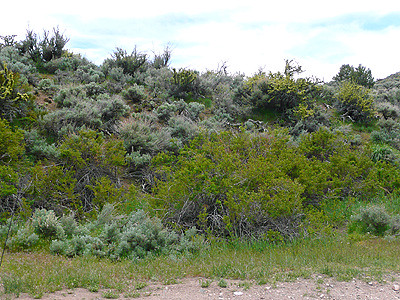
It’s a high-altitude desert, with plenty of mountains. The Sierra Nevada Range, to be exact.

There are waterfalls hidden in the hills.
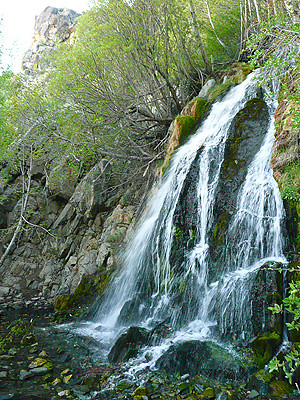
In some places, the sun shines golden emerald.
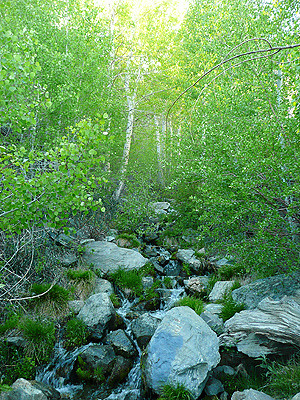
There are rocks to climb. (That’s my J.)
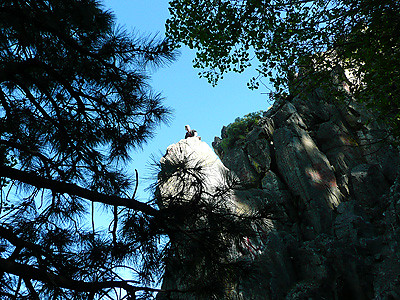
Trees still reach for you, even in the desert.
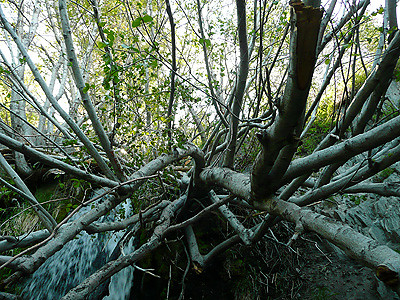
This is where I live. It’s pretty nice.
May 27th, 2010
No, I really didn’t. I had no clue that my beloved first fictional language was actually turning out to be comparable to a real human language. But, if someone who holds a Masters degree in Linguistics tells me something like that, I tend to believe him.
Uhjayi is a conlang – a constructed language – spoken by the inlanlu tahori, a species of tribal shapeshifters on a world known as Alasa Ka. Their universe is half-science and half-fantasy: magic and natural selection shape evolution, and a person must use both logic and spirit to thrive. Uhjayi itself is designed to approximate the form of communication an alien culture might use, given that one of their skins is remarkably similar to the one we humans wear all our lives.
Uhjayi is not a simple cypher that switches one letter for another. Uhjayi actually has a root-based vocabulary, object-subject-verb structure, and syntax that, I’ve been told, resembles some Asian languages. (None of which I speak, for the record, nor am I familiar with their skeletons.) Uhjayi’s current syntax has come about from what I think makes the most sense; the script is phonetic, the pronunciation using the English alphabet is standard across all its words, and the structure is simple, yet flexible.
After working on Uhjayi for some while, the above-mentioned bloke recommended Pimsleur to me as a better language-learning method than Rosetta Stone. (In tandem with my martial arts, and mostly because of it, I wanted to learn Japanese.) Instead of computer software, it consists of thirty-minute audio lessons in three sets of thirty lessons – roughly equivalent to one lesson a day for three months. I started daydreaming about recording Uhjayi lessons.
On a lark, I wrote the tentative transcript for the first lesson, using Pimsleur’s standard conversation format, and shared it with some friends. They responded overwhelmingly favorably. I wrote more lessons, made a mini-site (well, sub-blog), compiled vocabulary, and even recorded five-minute audio lessons to showcase the correct pronunciation. Thirty-minute lessons are definitely coming, but I’m still working on learning – and finishing – my own language first.
If you’re curious, you can find everything housed in the Learn Uhjayi blogsitething: lessons one through five, a vocabulary list, and the of-questionable-quality recordings of me saying some very strange things.
So, tell me: have you ever dabbled in any kind of fictional language?
February 21st, 2010

For all my multi-tasking and jack-of-all-trades-ness, I can be very single-minded at times. Almost everything that I learn in the Real WorldTM is immediately translated into my ability to convey plausible fiction. New recipes spark ideas about how a species might season their food. Taking my motorcycle apart is incorporated into how an individual works on her magic-powered vehicle. The texture of my cat’s fur correlates to the texture of an alien animal’s soft, glossy pelt. The unspoken social hierarchy in a certain group of people brings up questions on how another culture might function in a similar situation. You get the idea.
I am greatly fascinated by natural sciences – zoology, anatomy/physiology, evolution, botany, geology, astrophysics, and more. I am passionate about these subjects because they’re incredibly interesting to me, because I like understanding this amazing world in which we live– and because I want to use that knowledge to enhance my geofiction and my writing. It’s good to have a seemingly unique, seemingly possible idea to incorporate into a piece of worldbuilding; it’s much, much better to have the education and knowledge to back up that theory.
As part of my current walk in life, I plan on self-educating myself on the sciences in much greater detail than I’ve so far learned them. Natural sciences come first, followed by social sciences (especially psychology, religion/mythology, and ancient history), and then whatever else I’m curious about and might put to use (such as mechanics). I’m not doing this solely for my writing, but it is one of the primary motivations to find some solid texts and teach myself some of the innumerable things that I don’t know yet. Plus, it’s awesome! These subjects, this world, this universe, are all bizarre and beautiful. Lessening my ignorance will only teach me how much more there is to appreciate in this life.
How far do you go in the name of your craft? Do you casually pick up shards of information as they become necessary, or do you eagerly dive in to study the pillars on which you stand?
Image Credit: Crestock Creative Photos.
January 29th, 2010

Once upon a time, autumn came, and all the trees turned to dying colors. Rain fell; the skies faded to marbled grey. The leaves fell; the trees were naked with only their shadows for cloaks. The ground drowned as the sunlight waned, and the frost came to drape everything in shining blankness. All the color, the movement, the life had slipped away to hibernate until the warmth could return.
Happens every year. And every year, my heart slides down into dormancy, eyes heavy-lidded with weary darkness.
And every year, after the longest night right before Christmas, I say hello to the sun and welcome it home.
And every year, it isn’t until early February or thereabouts that I manage to rekindle the fire in my own spirit.
Doing anything of worth requires fire. Passion. Some form of love, some form of desire, some driving force that animates and fuels you. Even if your motivation is only survival, it is still your passion for life that keeps your heart beating and your hands working. If you didn’t care about life, you wouldn’t bother prolonging and improving it.
If you didn’t care about anything, you’d do nothing. It’s called apathy.
Passion enflames; passion propels. Writers write because they’re passionate about their stories and their characters. Artists paint or draw or sculpt because they’re passionate; musicians create and play music; athletes move their bodies; craftsmen create; everyone breathes. Nothing worth doing lacks passion from the doer.
When the sunlight is brief and the outside world is cold and bleak, it’s easy to lose sight of passion, of our reasons for doing things, of the source of our fuel. It’s cyclical, and not necessarily in such a large arc as the wheel of the year. It can happen in a month, or a week, or a day, or a lifetime.
But losing passion is only one part of the cycle. Shove through it and reach the next stage to recover yourself and reignite your heart. However many times you do it, it’s always necessary, and always worth the effort.
How do you keep the passion flowing in your life?
Image Credit: Crestock Creative Photos.
January 27th, 2010
You. Yes, you. No, not the spectre behind you. You.
You’re important.
I’ve been taking these first few weeks of the new year to let go of the old and breathe the new. I’m finding out I’ve let go of a few too many things, like my beloved sources of inspiration, and now I get to reconnect.
I’ve been reading things – sites, blogs, stories, journals. Trying to remember what got me stirred up. Figuring out why I came here and started building this house. I forget very easily – I live in the moment – and I had to go back, through written words, to re-realize a lot of my driving forces.
Most of those written words weren’t my own. They were yours. Your dreams, hopes, goals, ambitions. I draw strength and inspiration from the people who dare to follow their hearts, who push through the hard times to make better ones, who try to manifest their desires, whether those desires parallel my own or not.
Don’t ever doubt your own importance, even to people you’ve never personally spoken with. The internet lets us connect, but even when we don’t connect one-on-one, you influence people. You inspire them.
You inspire me. And for that, I thank you. I’ll try to return the favor as best I can, and I won’t waste the hope grown by your words.
February 2nd has long been a Day of Fire for me – to melt down the old in order to forge the new. It’s almost here, and I think I’ll be ready for it, now that I’ve remembered all I have to recycle and cultivate.
November 7th, 2009
 Today, boys and girls, I’m here to talk to you about drugs.
–wait, don’t hit the X. I said talk, not lecture. This is a blog about fiction! C’mon.
For the purpose of this post, I’m going to define ‘drug’ as any ingestible substance with physiological and/or psychological effects. Medicine, alcohol, and marijuana all fall under the drug heading here.
Almost every single person has an opinion about at least one drug. Drug A should be illegal, or Drug B should be legalized. Doing or distributing Drug C should put someone on death row, while doing or distributing Drug D should be considered saint’s work. Drug E should be used carefully; Drug F can be used willy-nilly. Drug G isn’t all that bad, but Drug H is hardcore. People who do Drug I are just looking to relax, but people who do Drug J are dangerous addicts. It’s socially acceptable to partake of Drug K at an event, but someone imbibing Drug L in public should get arrested. Drug M should always be done around people to be safe, while Drug N should only be done alone. Keep Drug O in the house, but Drug P can go on the streets, and Drug Q can even be done in the car without anyone dying.
You get my point.
Nearly every human culture has found a way to make alcohol, medicine, and narcotics. There’s a rich and fascinating history on drug production and use. My question to you is not a moral one, but a creative one: How do fictional cultures treat drugs? Not only fictional human cultures, but humanoid and non-human ones as well?
Is drug use so honed a science that the entire culture takes a variety of drugs for their every need, every day? Is drug use so horrifying a concept – loss of self-control a phobia – that the culture won’t even use medicine when it’s desperately needed? Which drugs are acceptable, and in what ways? Which drugs are unacceptable, and how is illegal use of them treated? What’s considered medicinal, and what’s considered recreational? Are drugs used for religious or spiritual purposes? Does military training include developing a high tolerance to certain common drugs, or even poisons?
How do the people in your stories deal with drugs? Get creative! Even human cultures have vastly different relationships with and opinions of mind-altering substances. You can drive home the alienness of a culture or race very easily by tweaking the place drugs have in that society.
Image Credit: Royalty Free Images.
October 29th, 2009
I’ve been mindspewing creature-designing and worldbuilding ideas in preparation for writing Oh, The Inhumanity!, an e-book on creating truly non-humanoid species, and I think I feel the tiny little flicker of a would-be rant guttering in my chest.
See, I have a pet peeve. Non-humans should be non-humans. In science fiction and fantasy alike, most of your non-humans are what I would consider humanoids – symmetrical bipedal races with human-parallel physiology and psychology. Some different clothing, a bit taller or shorter (or skinnier or wider – hi, elves and dwarves), pointy ears, colorful skin, and an accented version of the common tongue, and voilà! You have a humanoid. We, as human readers, can relate to the humanity of the race and its individuals, while (hopefully) appreciating the differences in body and culture.
That’s fine, that’s cool. That’s a distinct class of non-humans that are purposefully similar to humans for very understandable reasons. They’re the easiest to work with in fiction and most relatable for our audience.
When a book introduces a giant quadrupedal predator who still thinks like a civilized, social human, I get my hackles up. C’mon, guys. They aren’t human. Give them a difference. Let’s broaden our minds, shall we?
Imagine, if you will, a human being born with a set of animal behaviors and instincts. This is still a human in body and will be raised as a human, in human society, but its base instincts are some animal instead of evolved monkey. This person is inherently, innately, undeniably inhuman. If he’s a tiger, he’s going to have to balance social tendencies from his human rearing with completely antisocial tendencies from being a lone predator. There will be immutable qualities in the core of his psyche that are not human.
Imagine, if you will, a humanoid born into a human society. Even if she’s raised as a human, she’s going to have different base instincts and behavioral tendencies, as well as some moderately different physiological needs, depending on her specific race. Even though she will be effectively multicultural, she won’t lose her innate inhumanity that is her birthright as a non-human. She’ll likely experience internal (and possibly external) conflict over her adopted culture and her instinctual heritage.
Now, imagine a humanoid culture in its infancy. This species is now at the apex of their physical evolution and progressing into civilization and probably technology. For the sake of this example, say they have never met humans – they’re in a secluded land, or on a different planet. They don’t have our monkey instincts; they have their own. How differently would they develop, even if they have human-parallel bodies and neurological structures, when their core is unshakably inhuman?
Do I really need to ask you to imagine how different a non-humanoid race would be from us?
A Korat is not human. They do not have opposable thumbs; they do not stand on two legs. They have fur, claws, sharp teeth, and a predator’s set of movement-oriented senses. A human can gaze into a sunset and marvel at the incredible masterpiece of color and light; a Korat will look at a sunset and notice far less of the stationary detail. A human will see a blur of dull color in the underbrush and wonder if he imagined it; a Korat will watch a rabbit run and be able to count its strides out of the corner of his eye without even focusing. A human has different social needs than a Korat, different emotional and instinctual reactions to pain and fear and anger and sadness, and different ways of expressing himself. A human may react to danger with noisy aggression or cowering fear, while a Korat may react to the same situation by becoming completely still, alert, and poised to move – without any emotional investment.
Even when I find inhuman non-humans in fiction, I often find cases of human-envy. We are humans, so it’s natural that we’re human-centric. But Korats don’t pine for opposable thumbs or a bipedal gait. Korats don’t wish they were technologically advanced. In fact, Korats are Korat-centric – surprise! – and have a lot of racial pride. They like how their species is, and they don’t feel any inclination to become less like a Korat and more like anything else.
Humanoids certainly have a strong place in fiction, but I’d love to see more non-humanoids take a shining role with their differences and, yes, their incomprehensible alienness.
Have you ever created a non-human race that was truly inhuman? If not, why?
October 27th, 2009
Of all the people in the world, a fiction writer seems to be one of the least qualified to tell you to live in your body. Especially one who works as a computer geek. I spend my work and play hours on a computer, sitting down and trying to avoid numb-butt syndrome by stretching every now and then. I type 119 words per minute without any particular effort. I can tell when a graphic-in-progress in Photoshop is a pixel or two off. I’m a certifiable dork.
Who am I to ask if you’re present in your physical flesh?
Since we’re asking questions, how about this one: If you’re writing any sort of physical motion, how will you describe how it feels if you haven’t lived as a spine-flexing, muscle-contracting, blood-pumping body?
Everyone knows that writers can and do write things they haven’t personally experienced. “Write what you know” is a common adage, seemingly in contradiction to our immense imaginations. Take them both in moderation and consider this: how different would a short story about drag-racing be if the author had never even gotten his driver’s license? How would you write about a long cross-country journey if you’ve never walked through the woods? Sure, research and second-hand stories are great, but do they really replace personal experience?
Stephen R. Boyett wrote a great article about The One True Thing. He writes fantasy, but he gathers as much real-life experience pertaining to that fantasy as possible, so that he can include genuine details that make the unbelievable a little more real. Tiny things like road signs, the oft-overlooked decorations on large buildings, and that one tree that juts up from that hill over there when you’re driving down the highway. As a result of these True Things, his readers can suspend disbelief all the more easily.
And, really, can you write a story without ever having a physical body moving?
Are you present enough in your own skin to make it believable?
Give me the one true thing. The sudden rush of heat following a sharp pain; the sensitivity of your fingertip when a long nail is suddenly chopped short; the itch of a necklace chain on your collarbone. Make me believe that your character is just as alive as me – even if he’s the farthest thing from human you can get.
Live it, and let your stories benefit from your life.
October 19th, 2009

I have a veritable history with NaNoWriMo. I began participating in 2003 and, with one exception, have won every year since.
In 2003, I had written only one novel before; it was The Dark Wars, an unfinished Young Adult story about the most memorable and violent time in Lavana‘s history. It spanned five spiral-bound notebooks – yes, I had written the entire thing by hand. But, in 2003, I was a fast typist, and my NaNovel was done on computer. It was entitled Seeker, a story about two gay boys in college trying to find themselves and finding each other instead. (Shh. It wasn’t a real romance, I swear.) While I got 50,000 words on the story, the plot arc was far from complete. This would set the norm for all NaNovels to come.
In 2004, I wrote Outcast, my first Korat-only novel. I got 80% finished with the story arc by the time I crossed the 50k finish line, which was the closest I’d come to completing an entire novel in my life. I even skipped ahead and wrote the ending scene (which, sadly, I later lost). Outcast followed the story of a lone striped female as she never stopped running for her life, even when she encountered three people who actually didn’t want to kill her.
In 2005, I wrote The Panthera Walkers: Peace as part of a Panthera Walkers trilogy (the second book, might I add – the first and third unwritten). Set in Ykinde, TPW:P chronicled the story of the growing Walker tribe and their aid in trying to establish peace between Lupos and Avans – trying to end the Elderwar – and how nothing is ever as black-and-white as it seems. I had a lot of trouble that year and took a major plot detour, then had to write feverishly to catch up and cross the finish line – at something like seven minutes ’til midnight on the last day. It was nuts.
In 2006, I failed. I did participate, and scanning back over my personal journal for November, I wrote that I’d gotten 21k on something. For the life of me, I can’t remember what it was, so I’m inclined to think it was a bunch of false starts and half-baked stories. My only excuse was that two great friends of mine were visiting for two weeks from Britain, and I was out and about with them almost every day they were here. (Sure, I was working full-time, too, but I’d been working every November except for 2003 – and in 2004, I was taking a few college classes as well as holding a job!)
In 2007, the miracle that was The Demon-God of Jubagh came to pass. By the time November rolled around, I’d already finished Book One; that year’s NaNoWriMo saw Book Two and half of Book Three completed before the 30th, and the rest of Book Three finished before the December holidays. I’ve already discussed TDGoJ previously on here (see the above link), but let me tell you – this was the first (and so far only) time I’d truly, totally, 100% finished a novel. I was gleeful.
In 2008, last year, I struggled to pick a direction for the first week or so. I first veered towards an anthology of myths and stories of Redwood, sidifir oerri, ageless mother of the Koratian race. I thought I could do two novels in one month, since I was on part-time at work and would never have that much free time ever again, so I tried to do a story about animetals on Ryarna in that world’s equivalent of the Wild West. Both petered out within days, and then – thanks in large part to some brainfodder and a great friend being a sounding board – I got inspired to do Into Fang Wood. I flew past the finish line, half-crazed and gibbering from the chaos of trying to wrangle that story in a month. (Later, of course, I found out how big it wanted to be, and I quailed, and then I began outlining…)
In 2009, this year, I have something very fun planned. The incredibly tentative working title is The Ghost In The Machine. (Asimov, I salute you, sir.) Set in the Gurhai universe, it will feature three corata, shapeshifting mammalian predators, who find themselves on Ryarna by chance or by fate. They encounter an impossible thing: a feral, instinct-smart herd of motorcycle-like wheeled vehicles that are, apparently, bound to and powered by animal ghosts. It’s illegal to fuse a ghost to anything but an animetal shell, however, and these wheelers are meant for personal transportation alone – not animation. Not only do the corata have to survive the largely-without-fleshy-animals desert, they have to figure out how to survive increasingly restless, doggedly stubborn aniwheelers.
It’s going to be so much fun.
Fellow WriMos, what are you planning for this lovely November?